


The safest, lowest-effort approach to sun protection on the trail is a clothing-first system: cover as much skin as you comfortably can with UPF gear, then use a broad-spectrum, water-resistant SPF 30 to 50 sunscreen on everything left exposed. Reapplication matters more than which SPF number you picked. Carry a stick for your face and ears, a tube or spray for your arms and legs, and treat both as gear you use on a schedule, not an afterthought.
TL;DR:
- Cover as much skin as possible with UPF gear, such as shirts and hats, before applying sunscreen to reduce the need for frequent reapplications.
- Use broad-spectrum, water-resistant sunscreen with at least SPF 30, and consider SPF 50 for high-altitude or reflective environments, reapplying every two hours.
- Mineral sunscreens like zinc oxide offer immediate protection and are less irritating, making them preferable for frequent reapplication during strenuous hikes.
- Applying about a full shot glass of sunscreen for the entire body lasts only if worn at the recommended 2 mg per square centimeter, yet most hikers apply significantly less.
- Elevation, reflection from snow or water, and cloud cover heighten UV exposure, so SPF 50 and additional UPF layers are essential under these conditions.
Table of Contents
- What Should You Wear Before You Even Reach for Sunscreen?
- How Do You Choose the Right Sunscreen for Hiking?
- How Much Sunscreen Do You Actually Need to Apply?
- What Belongs in Your Sun-Protection Kit?
- Does Altitude or Weather Actually Change How Much Protection You Need?
- What Are Hikers Getting Wrong Most Often?
- What Miami Beach Bum Knows About Sun Protection on the Trail
- An Editorial Take on What Actually Works on Trail
- A Trail-Ready Way to Cover the Gaps
- Sources
- FAQ
What Should You Wear Before You Even Reach for Sunscreen?
Every inch of skin covered by a shirt is an inch you don’t have to remember to reapply sunscreen on. That’s the entire logic behind a clothing-first system, and it’s why serious hikers treat UPF gear as the base layer of sun protection, not an accessory.
UPF stands for Ultraviolet Protection Factor, the fabric equivalent of SPF. A garment rated UPF 50+ blocks about 98% of UV radiation, and unlike sunscreen, it doesn’t wear off, sweat away, or need reapplying every couple hours. That reliability is the real advantage: once you put on a UPF hoodie, that skin is protected for the whole hike.
A wide-brim hat shields your ears, scalp, and the back of your neck, three spots sunscreen users chronically miss. Pair it with sunglasses rated UV400 or “100% UVA/UVB protection.” Dark lenses alone don’t guarantee UV blocking, and unprotected eyes take real UV damage on bright, high-altitude trails.
When shopping for trail gear, look for:
- A printed UPF number on the tag (UPF 30 is good, UPF 50+ is better)
- Lightweight, breathable weave so the fabric doesn’t trap heat
- Thumb loops or half-sleeves that keep hands covered without adding bulk
- A hat with a brim wide enough to shade your ears, not just your forehead
Pro Tip: A light-colored sun hoodie with a hood built in covers your neck and lower ears in one layer, cutting down the number of times you need to reach for a sunscreen stick.
How Do You Choose the Right Sunscreen for Hiking?
Start with two non-negotiables: broad-spectrum protection and SPF 30 as your floor. Dermatology guidance from the American Academy of Dermatology recommends broad-spectrum, water-resistant sunscreen at SPF 30 or higher for outdoor activity, and SPF 50 makes sense for long days, high-altitude routes, or trails with heavy reflection from snow, water, or light rock.
SPF 30 filters out roughly 97% of UVB rays, while SPF 50 filters about 98%. That one-point difference matters far less than whether you reapply on schedule.
Beyond SPF, the mineral-versus-chemical choice shapes how well a sunscreen actually performs in the field:
- Mineral (zinc oxide, titanium dioxide): Sits on top of skin as a physical barrier, works the moment you apply it, and is less likely to sting eyes during heavy sweating. The trade-off is a visible white cast on some skin tones, though tinted mineral formulas have largely closed that gap.
- Chemical filters: Blend in clear and feel lighter, but some formulas irritate eyes on a sweaty ascent and raise more reef-safety questions in marine environments.
Water-resistance labels aren’t marketing fluff. They’re tested in controlled conditions to last either 40 or 80 minutes of swimming or sweating before reapplication is required. For anything more strenuous than a flat, shaded walk, favor the 80-minute formulas and treat that number as a countdown timer, not a guarantee.
Format matters as much as formula. Sticks work best on the face, ears, and part line where you need precision without drips. Sprays cover arms and legs fast but require rubbing in to reach the 2 mg/cm² testing standard. Small tubes are the easiest thing to top off with mid-hike without digging through your full pack.
How Much Sunscreen Do You Actually Need to Apply?
Lab testing that produces the SPF number on your bottle assumes a coating of about 2 mg per square centimeter of skin, which works out to roughly a full shot glass for one adult’s entire body. Most people apply less than half that amount, and the FDA notes that under-applying an SPF 50 product can drop your real-world protection to somewhere near SPF 7.
Here’s how to hit the real target on trail:
- Apply 15 to 20 minutes before you start hiking, giving the sunscreen time to bind to skin.
- Use a nickel-to-pearl-sized amount for your face alone, and don’t skimp on ears, nose, and part line.
- Reapply at least every two hours, and sooner if you’re sweating heavily or crossing water.
- Use a stick for hard-to-reach or hairy spots (part line, ears, feet) where sprays and lotions run or miss.
- Rub in sprays fully, since a quick mist without rubbing rarely reaches the tested application thickness.
Build reapplication into breaks you’re already taking. Every snack stop or water refill is a built-in reminder: pull out the stick, hit your face and ears, done in fifteen seconds. Commonly missed spots include the tops of your feet if you’re in trail runners, the back of your neck below a short hat brim, and the thin skin along your hairline.
Pro Tip: Set your watch or phone to buzz every two hours on long days. It’s a small habit that closes the gap between the SPF number on the bottle and the protection you’re actually getting.
What Belongs in Your Sun-Protection Kit?
A minimal, trail-ready kit fits in two pockets:
- Sunscreen stick for face, ears, and part line, stored in a hip-belt pocket for one-handed access
- Small tube or travel-size lotion or spray for arms, legs, and body, refilled before multi-day trips
- SPF lip balm, since lips have no melanin protection and burn fast at altitude
- UPF hat and sunglasses worn from the trailhead, not packed for later
Your routine should run on a simple timeline: apply before you leave the car, check in at every major rest stop, and always reapply after a stream crossing or a stretch of heavy sweating.
For multi-day trips, plan on roughly 1 ounce (30 mL) per person for every 2 to 3 hours of exposure if you’re only covering face and exposed limbs; a fully clothed hiker in UPF gear needs a fraction of that. If you’d rather carry less sunscreen altogether, lean harder on UPF sleeves, a longer hat brim, and simply taking breaks in shade during peak midday hours.
Does Altitude or Weather Actually Change How Much Protection You Need?
Yes, and most hikers underestimate it. UV exposure climbs with elevation, and NOAA’s guidance notes UV intensity increases meaningfully as you gain altitude, while snow, water, and light-colored rock reflect additional UV back at you from below, exposing the underside of your chin and nose in ways flat ground never does.
Cloud cover is not protection. Up to 80% of UV radiation passes through clouds, so an overcast alpine trail can burn you just as fast as a clear one. Check the UV Index for the day instead of judging by how sunny it looks.
When altitude and reflection stack together—snowfields in spring or alpine lakes at midday—adjust accordingly: lean on SPF 50, keep sunglasses on, and don’t loosen the UPF layers just because it feels cool.
What Are Hikers Getting Wrong Most Often?
Under-application is the single biggest failure, and it’s an easy fix once you know the real testing amount. A few other patterns show up again and again on trail:
- Skipping ears, hairline, and the tops of feet because they’re awkward to reach with fingers
- Choosing a sunscreen that stings eyes or feels greasy, then quietly skipping reapplication because it’s unpleasant
- Relying on one morning application to last an entire eight-hour summit day
- Wearing a UPF shirt but leaving the neck and lower ears exposed under a short-brim hat
Pro Tip: If a sunscreen stings your eyes on the first application, switch formulas before your next hike. Comfort is what actually determines whether you’ll reapply, and adherence beats marginal SPF differences every time.
What Miami Beach Bum Knows About Sun Protection on the Trail
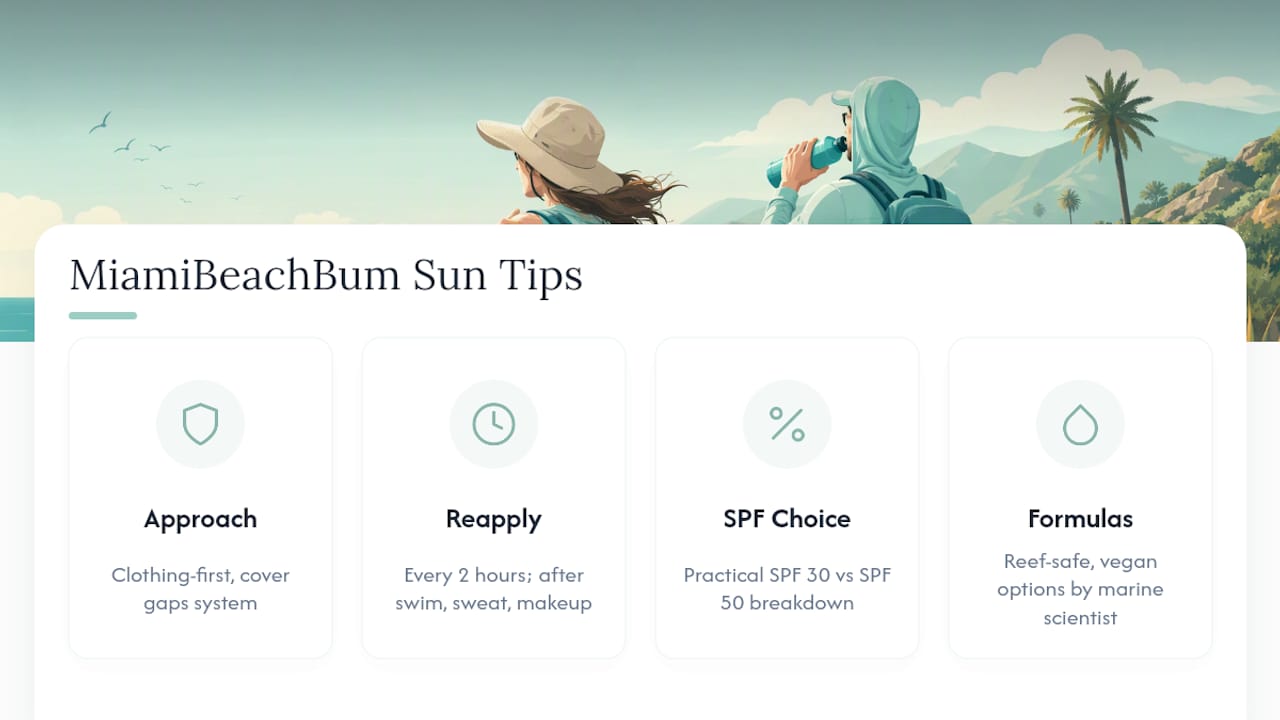
Miamibeachbum builds its guidance around the same clothing-first, gaps-covered system this article recommends, drawn from ongoing coverage of real sun-care problems hikers and beachgoers run into. That includes posts on fixing white cast from tinted mineral sunscreen, how often to reapply during swims, sweat, or over makeup, and a direct breakdown of SPF 30 vs SPF 50 for readers deciding which to pack.
Author Ayssa covers sun protection and body care for Miamibeachbum, focusing on practical, trail-and-beach-tested advice rather than lab theory. Some reef-safe, vegan formulas are built by a marine scientist for sensitive and breakout-prone skin, which matters directly for hikers who need a formula they can wear all day without irritation.
An Editorial Take on What Actually Works on Trail
Most sun-protection advice obsesses over SPF numbers when the real variable is behavior. A hiker in SPF 30 who reapplies every two hours is better protected than one in SPF 50 who applies once at the trailhead and forgets. My honest habit: reapply at every snack break, not on a strict clock, and keep a face stick in the hip pocket where it’s genuinely no effort to grab. Clothing does the heavy lifting; sunscreen just covers what’s left.
— Ayssa
A Trail-Ready Way to Cover the Gaps
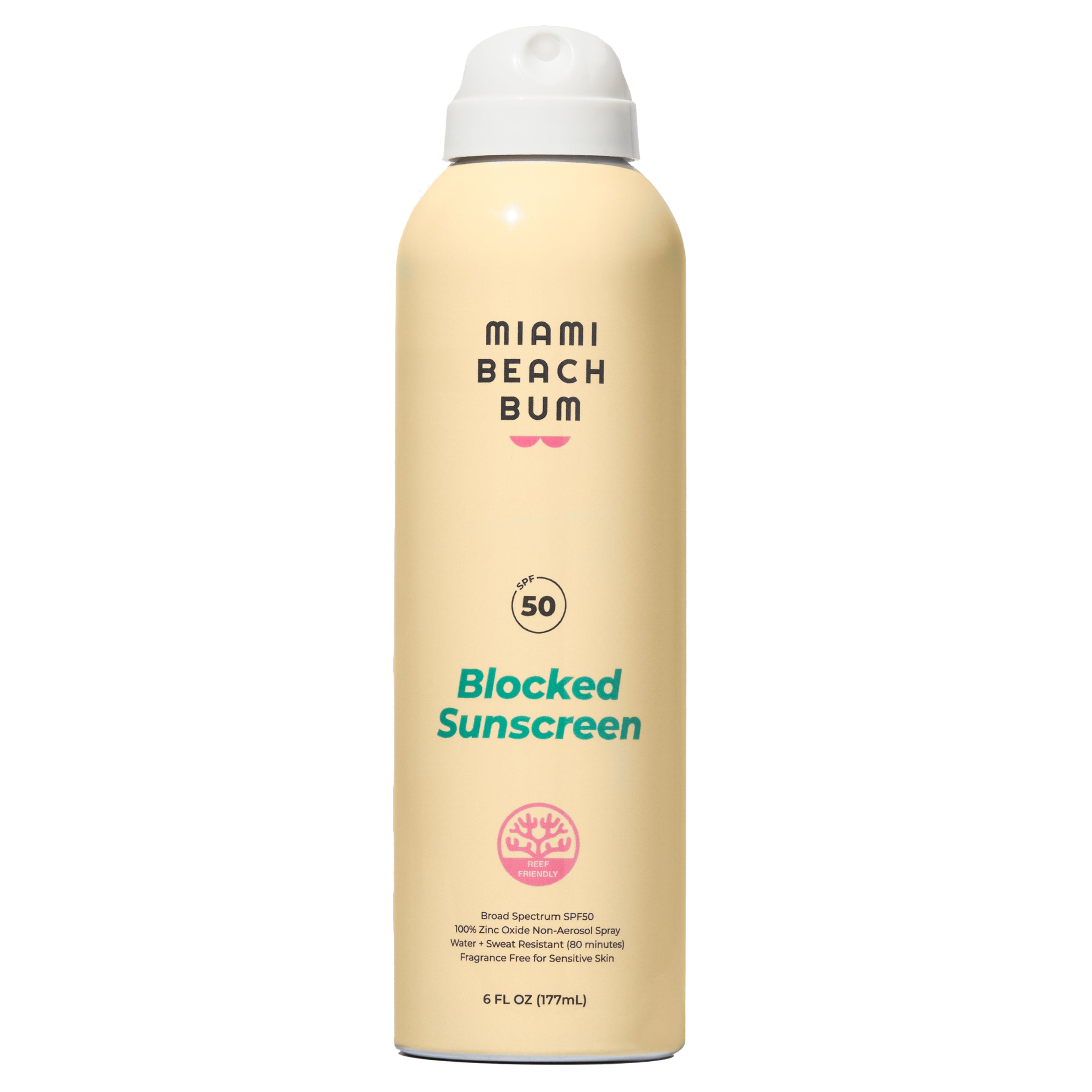
Miamibeachbum’s Blocked SPF50 is built as reef-safe, mineral protection for exactly the exposed-skin gaps a clothing-first system leaves behind, formulated by a marine scientist for sensitive, breakout-prone skin without petroleum or harsh chemicals.
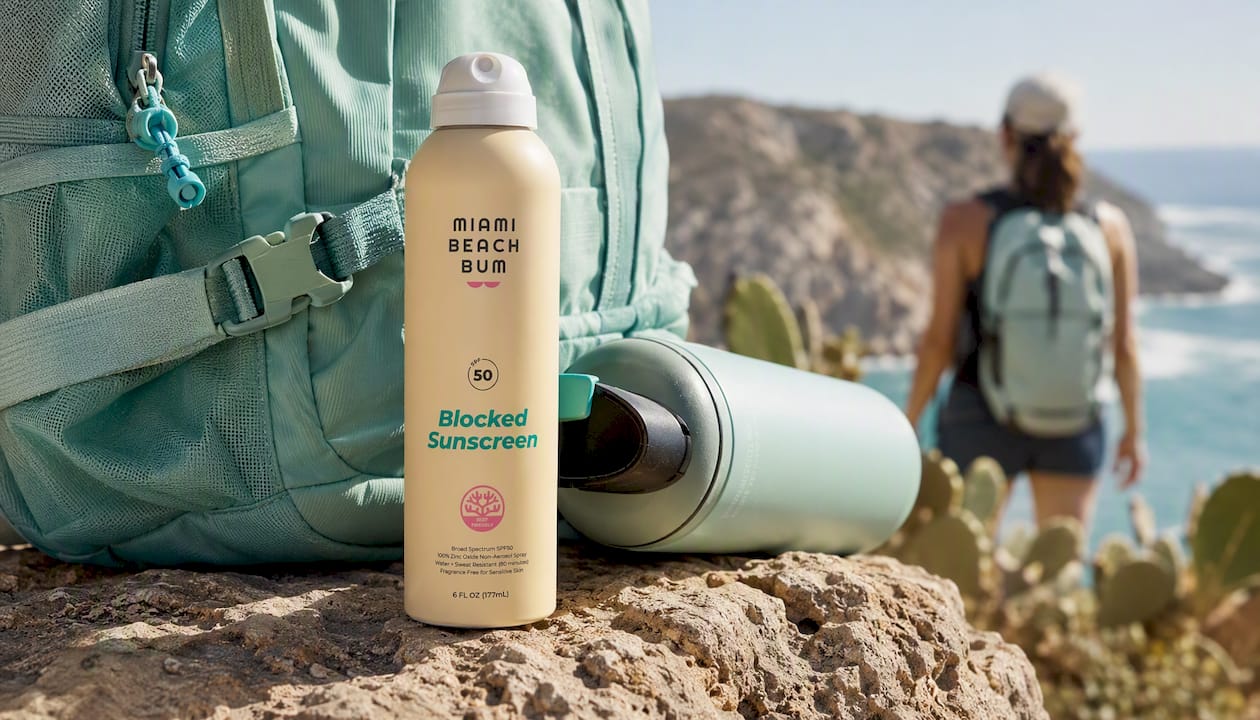
Body needs and face needs aren’t the same on trail. The Bodycare collection covers larger surface areas like arms, legs, and shoulders, while the Outdoor collection is built around packable formats, sticks, sprays, and travel sizes, that fit a hip-belt pocket without adding real weight to your pack. If your current sunscreen stings your eyes by mile four or leaves a heavy white cast under a hat brim, that’s worth fixing before your next long day out. Check both collections and pick the formats that match your next trip’s mileage and climate.
Sources
FAQ
What SPF should I use for hiking?
Use broad-spectrum, water-resistant sunscreen with a minimum of SPF 30, and step up to SPF 50 for long days, high altitude, or trails with heavy snow, water, or rock reflection. The SPF number matters less than applying enough and reapplying on schedule.
Why do hikers eat gummy bears?
Gummy bears and similar sugary snacks give hikers a fast, portable source of quick-digesting carbohydrates for a mid-hike energy boost. It’s unrelated to sun protection, but many hikers pair a snack break with sunscreen reapplication since both happen on the same rest-stop schedule.
Are you supposed to use SPF 30 or 50?
Either works as long as it’s broad-spectrum and applied generously; SPF 30 blocks about 97% of UVB rays and SPF 50 blocks about 98%, a small gap compared to how consistently you reapply. Choose SPF 50 specifically for high-altitude, snow, or water-heavy routes where reflection increases exposure.
What type of sunscreen is best for trekking?
A water-resistant, broad-spectrum formula rated for 80 minutes of sweat or water resistance holds up best on strenuous treks. Mineral formulas like Miamibeachbum’s Blocked SPF50 work well for sensitive skin and reduce eye sting during heavy sweating, while a stick format makes reapplying ears and part lines easier on the move.
How often should I reapply sunscreen while hiking?
Reapply at least every two hours, and sooner after heavy sweating or wading through water. Building reapplication into snack and water breaks makes it far easier to stick to that schedule across a full day on trail.