


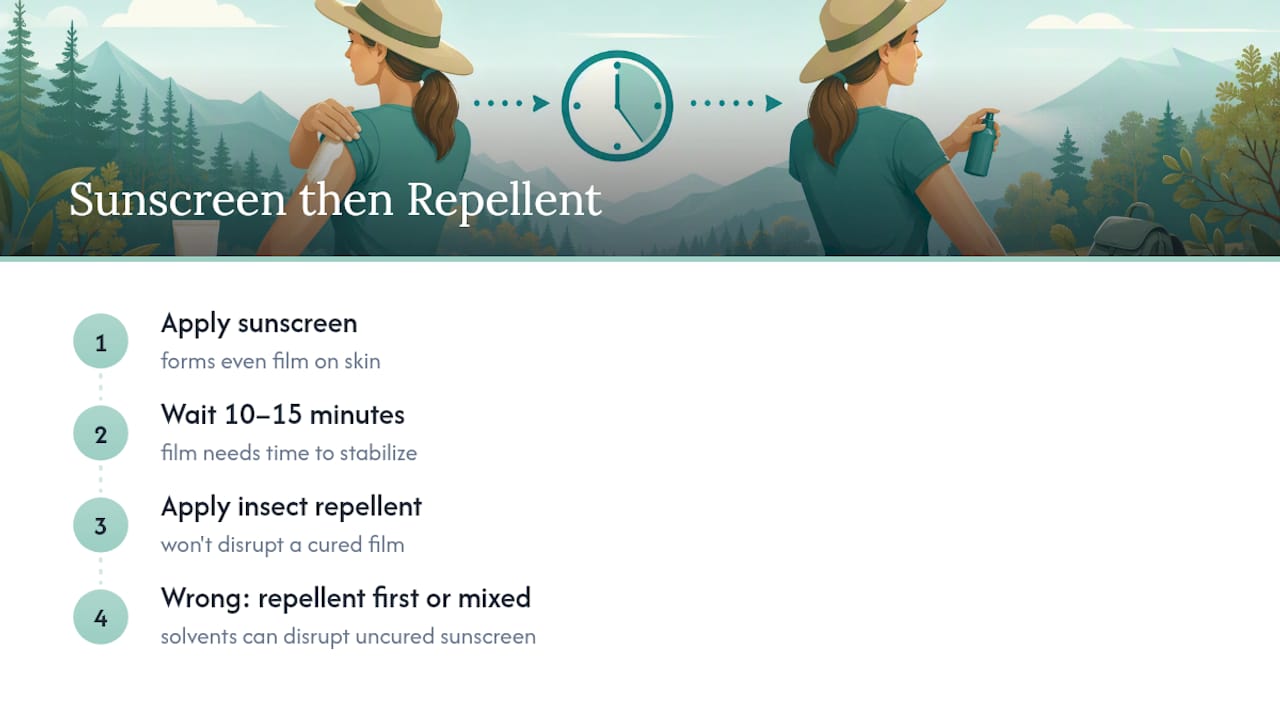
Apply sunscreen first, wait until it dries, then apply insect repellent. This order isn’t a preference; it’s the sequence endorsed by the CDC and echoed by dermatology and consumer-safety experts. Give sunscreen some time to absorb before repellent goes on. Reverse that order and you risk diluting your SPF right when you need it most.
TL;DR:
- Applying sunscreen first and waiting 10 to 15 minutes ensures it forms an even film and is not diluted by subsequent repellent application.
- Reapplying sunscreen every two hours and repellent every four to eight hours optimizes protection while minimizing chemical exposure.
- Combining DEET-based repellent with sunscreen can decrease SPF by more than 30% and increase chemical absorption if not applied separately.
- For children and face application, spray repellent into hands and pat onto skin to avoid eyes, mouth, and inhalation risks.
- Products claiming to combine sunscreen and repellent often reduce SPF performance and offer less control over reapplication timing.
Table of Contents
- Sunscreen or Bug Spray First? Why the Order Matters
- How to Layer Sunscreen and Repellent the Right Way
- The Science Behind Sunscreen and Bug Spray Timing
- Applying Sunscreen and Repellent for Kids, Swimmers, and Face Areas
- Why Combined Sunscreen and Repellent Products Fall Short
- What Miamibeachbum Has Learned From Real Outdoor Testing
- A Simple Rule Worth Repeating
- Totally Buggin’ Fits the Sunscreen-First Routine
- Where This Guidance Comes From
- Sources
Sunscreen or Bug Spray First? Why the Order Matters
The sequence matters because these two products behave differently on skin, and mixing up the order changes how well each one works. Sunscreen needs contact time to form an even film on the skin’s surface. Repellent doesn’t need to bond the same way, but its chemical carriers can interfere with a sunscreen film that hasn’t fully set. That’s the entire reason authorities frame this as sunscreen first, not bug spray first: one product needs to cure, the other doesn’t.
Applying repellent before sunscreen, or rubbing both on at once, gives insect-repellent solvents a chance to disrupt the sunscreen layer before it has a chance to stabilize. That’s the mechanical reason behind the advice, and it holds whether you’re using a mineral formula or a chemical one.
How to Layer Sunscreen and Repellent the Right Way
Getting the order right is only half the job. Technique matters just as much, especially with spray products where under-application is the most common mistake.
- Start with clean, dry skin. Sunscreen bonds poorly over sweat, sand, or leftover lotion, so rinse off and pat dry before you begin.
- Choose broad-spectrum SPF 30 or higher. For full-body coverage, dermatologists commonly reference the “one ounce” rule, roughly a shot glass full, to cover an adult in a swimsuit.
- Apply sunscreen thoroughly and rub it in. If you’re using a spray, Miamibeachbum’s 6 seconds per limb method gives you a repeatable way to avoid the thin spots that cause burns, then rub it in by hand.
- Wait 10 to 15 minutes. This is the step people skip. Consumer Reports and the CDC both call out this window as the time sunscreen needs to dry down and stop feeling tacky.
- Apply repellent over the dried sunscreen. Spray or rub it into exposed skin or clothing per the label. For your face, spray into your hands first, then pat it on, avoiding your eyes, mouth, and any broken skin.
- Reapply on separate schedules. Sunscreen comes off with water, sweat, and towel-drying, so reapply it every two hours, or immediately after swimming. Repellent lasts longer; check the label for its specific reapplication window rather than guessing.
Pro Tip: If you’re layering sunscreen with a body lotion or after-sun product too, apply lotion first, let it absorb, then sunscreen, then repellent. Our guide to layering sunscreen and body lotion walks through the full stacking order.
The Science Behind Sunscreen and Bug Spray Timing
The concern isn’t hypothetical. Combining DEET-based repellent with sunscreen has been shown in some testing to cut measured SPF by more than 30%, a meaningful drop when you’re counting on that number to prevent burns during hours outdoors. DEET can also increase how much of itself, and potentially how much sunscreen chemical, gets absorbed through skin when the two are applied together or too close in sequence.
The two products aren’t doing the same job, which is part of why order matters:
- Sunscreen sits on the skin’s surface and either absorbs or reflects UV rays before they reach living tissue.
- Repellent works by masking the scent cues bugs use to find you, and it needs skin contact, not a barrier layer, to do that effectively.
- Sunscreen degrades with water, sweat, and time, requiring reapplication every two hours.
- Most repellents last four to eight hours per label directions, so reapplying them on a sunscreen schedule wastes product and increases chemical exposure for no benefit.
Following the EPA’s guidance on both labels, rather than assuming they match, avoids over-application of either one.
Applying Sunscreen and Repellent for Kids, Swimmers, and Face Areas
Special situations call for adjustments to the basic routine.
- Children: Never spray repellent directly onto a child’s face. Spray it into your own hands first, then apply carefully, avoiding eyes, mouth, and hands that might end up in a mouth. The American Academy of Pediatrics recommends age-appropriate DEET concentrations and following label directions closely for younger kids.
- Swimmers and sweaters: Water-resistant sunscreen still wears off, just more slowly. Reapply after swimming or heavy sweating, then reapply repellent only if your label’s timeframe has passed, not automatically alongside sunscreen.
- Repellent type: DEET and icaridin are longer-lasting and well-studied for effectiveness. Plant-based options like oil of lemon eucalyptus (OLE) work but typically need more frequent reapplication, so check the label rather than assuming equal coverage time.
Why Combined Sunscreen and Repellent Products Fall Short
Products that promise sunscreen and repellent in one bottle sound convenient, but public-health guidance consistently steers people away from them. The core problem is chemistry: combining the two can reduce SPF performance compared to applying each product on its own.
There’s also a mismatch built into how often each product needs reapplying:
- Sunscreen needs fresh coats every two hours; repellent typically doesn’t.
- Reapplying a combo product on a sunscreen schedule means overexposing skin to repellent chemicals, a bigger concern for kids.
- Combo formulas make it harder to control dosage of either ingredient precisely.
Separate products give you control over how much of each ingredient you’re using and when, which a single bottle can’t offer.
If you’re ever stuck with a combo product in hand, at minimum follow its label exactly and don’t reapply more often than it specifies for either function.
What Miamibeachbum Has Learned From Real Outdoor Testing
Miamibeachbum’s product lead, Ayssa, has spent years refining sun-care routines for beach days, hikes, and outdoor events, and that hands-on experience shapes how the brand talks about layering with Bug Away Mesh. The 6-seconds-per-limb technique came out of watching how often spray sunscreen gets under-applied in real conditions, not lab settings.
That same practical lens applies to repellent. Totally Buggin’ is built to slot in after sunscreen, not before or instead of it, matching the sequence this article recommends. For anyone prepping for a long outdoor event rather than a quick errand, the outdoor concert sun-prep guide breaks down timing for a full day away from shade. Anyone unsure where they’re going wrong with layering should also check the common combo mistakes post before their next trip.
A Simple Rule Worth Repeating
The order isn’t complicated once it clicks: sunscreen protects your skin from the sun, repellent protects you from bites, and the first one needs a head start to work right. I’d rather see someone wait the extra 10 minutes than skip it and end up reapplying a weaker sunscreen all afternoon. Before you head out the door, run through this:
- Apply sunscreen generously.
- Wait 10 to 15 minutes.
- Apply repellent, hands-first on the face.
- Reapply sunscreen every two hours or after swimming.
- Check both labels if you have sensitive skin or a medical condition, and talk to a doctor about any reaction.
— Ayssa
Totally Buggin’ Fits the Sunscreen-First Routine
Miamibeachbum makes this exact routine simple to follow with one product built for it. Totally Buggin’ is a botanical, reef-safe repellent formulated to go on after sunscreen without the greasy layering mess some sprays leave behind. It’s a fit for readers who want a repellent that doesn’t force a tradeoff between bite protection and reef-conscious ingredients.
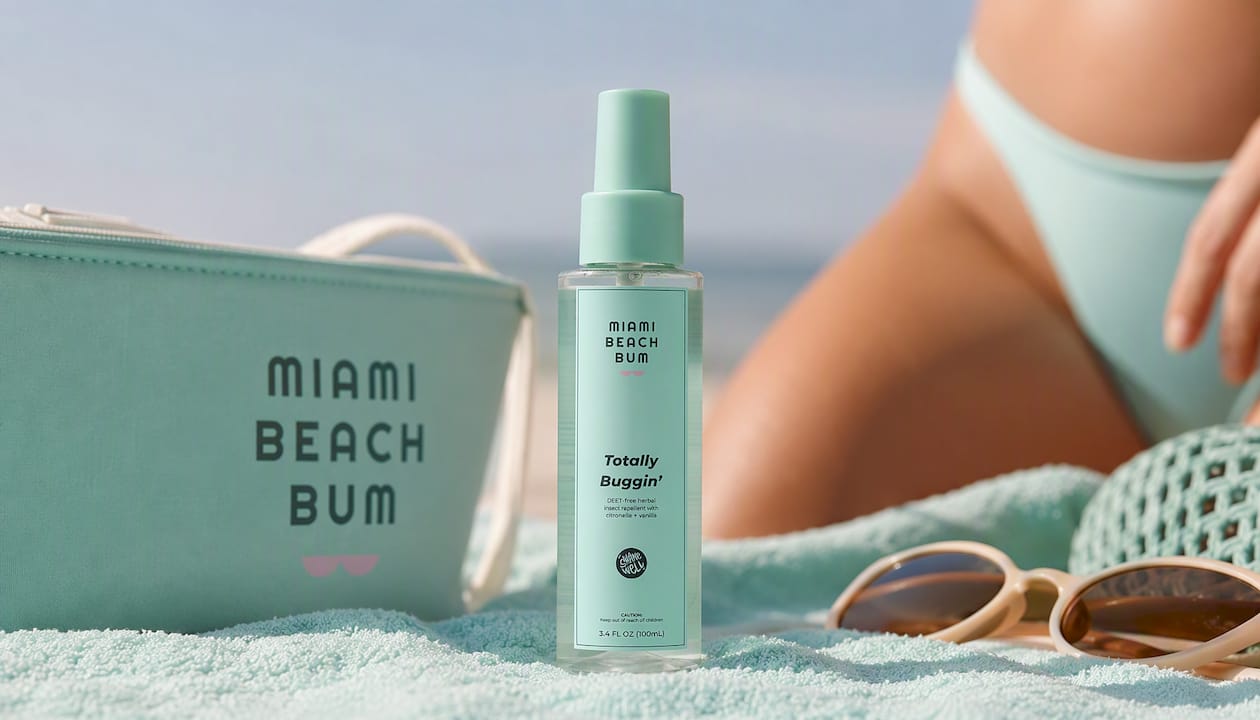
Use it the same way you’d use any repellent in this routine: apply your sunscreen, wait until it’s dry, then spray Totally Buggin’ onto exposed skin or clothing, keeping it off your face directly by spraying into your hands first. Reapply according to the label rather than on your sunscreen’s two-hour clock. If you’re building out a full beach or hiking kit, check out Totally Buggin’ here and pair it with a mineral sunscreen spray for a routine that covers both jobs without guesswork.
Where This Guidance Comes From
The routine in this article draws directly from the agencies and organizations that set the safety standards for sunscreen and repellent use.
- CDC Yellow Book: the primary source for the sunscreen-first order and timing.
- Skincancer: explains SPF loss from combo products.
- Consumer Reports: practical reapplication timing.
- American Academy of Pediatrics: child-specific safety rules.
Sources
- CDC: Mosquitoes, ticks, and other arthropods — Yellow Book
- Skincancer
- Consumer Reports: How to apply bug spray
- American Academy of Pediatrics: Insect repellents