


A white cast comes from mineral filters like zinc oxide and titanium dioxide scattering visible light back off your skin instead of letting it pass through. The fastest fix is switching to a tinted or tone-adapting mineral formula and applying it in thin, pressed-in layers rather than one thick swipe.
TL;DR:
- Using tinted or tone-adapting mineral sunscreens significantly reduces visible white cast, especially on medium to deep skin tones, by masking zinc oxide and titanium dioxide pigments.
- Applying the product in thin, even layers and fully pressing it in helps prevent uneven whiteness and improves overall cosmetic appearance.
- Higher concentrations of zinc oxide increase whiteness measurement, making lower percentages preferable for achieving a clearer finish without sacrificing protection.
- New physical shapes like tetrapod zinc oxide particles can reduce chalky appearance without relying on tinting or coatings.
- Layering makeup or skincare over mineral sunscreens should be done carefully with lightweight, thin applications to avoid trapping residue and accentuating whiteness.
Table of Contents
- Why mineral filters cause white cast: particles, light scattering, and formulation trade-offs
- How white cast shows up differently across skin tones
- How to avoid or minimize white cast today
- Shopping checklist: what to look for on labels
- The science behind reducing white cast
- Layering sunscreen with skincare and makeup without making cast worse
- Where Miami Beach Bum® stands on mineral finish
- Product spotlight: why Blocked SPF50 follows this exact checklist
- Sources
Why mineral filters cause white cast: particles, light scattering, and formulation trade-offs
Zinc oxide (ZnO) and titanium dioxide (TiO2) are white solid particles by nature. When light hits them, they reflect and scatter visible wavelengths, and your eye reads that scattering as a chalky or ashy tint on skin. The bigger the particle or the more it clumps together, the more light bounces off unevenly, and the whiter the cast looks.
Formulators fight this in a few ways:
- Micronizing the particles down to a smaller, more uniform size so they scatter less visible light
- Coating particles with silicones or other agents to change how they disperse in the base formula
- Adjusting the overall concentration of active mineral filters to balance protection against visible residue
None of these fixes is free. Micronized particles can be harder to disperse evenly, coatings add cost and formulation complexity, and lowering ZnO or TiO2 concentration too far risks under protecting skin.
The relationship between concentration and cast isn’t subtle. A white-cast scoring protocol combining subjective grading with CIELab* colorimetry found that as ZnO percentage rises, measured whiteness (L*) rises with it, with higher ZnO concentrations producing scores testers rated unacceptable. Cosmetic chemists describe mineral actives as inherently white powders, meaning the real goal isn’t making them invisible. It’s making them cosmetically elegant through better dispersion, coating, or tinting.
How white cast shows up differently across skin tones
The same optical scattering event reads very differently depending on what’s underneath it. On fair skin, a thin mineral layer often just adds a faint brightening or slightly pale sheen that blends in quickly. On medium to deep skin tones, that identical layer can look chalky, gray, or ashy, because the white particles contrast sharply against darker melanin.
This isn’t just a cosmetic annoyance. It’s a public health issue. When sunscreen visibly clashes with someone’s skin tone, they’re less likely to apply enough of it, or to reapply at all, which raises real risk for UV-related hyperpigmentation and long-term sun damage.
Formulators now try to quantify this problem instead of guessing at it:
- Objective colorimetry (CIELab* measurement) tracks exact whiteness shifts on different base tones
- Subjective grading panels pair with those measurements to predict how real users will perceive the finish
- Combined scoring lets brands compare formulas before they ever reach shelves
How to avoid or minimize white cast today
You have more control over this than most product labels suggest. Here’s the order of operations that actually moves the needle.
- Choose a tinted or tone-adapting mineral formula. Iron oxides in the base mask the white pigment of zinc oxide and titanium dioxide, which is currently one of the most effective ways to reduce visible cast and keeping mineral protection intact.
- Shake the bottle or tube thoroughly. Mineral actives settle, and an unshaken formula applies unevenly, concentrating whiteness in some spots and leaving others under protected.
- Apply in thin, even layers. Piling on one thick coat increases visible residue disproportionately; two thin layers, a few minutes apart, spread pigment more evenly than one heavy pass.
- Rub or press the product in fully. Don’t stop at the first sign it’s blended. Give it another 30 seconds of working in, especially around hairlines, ears, and joints where residue collects.
- Let it set before adding makeup. Mineral formulas often shift color slightly as they finish absorbing, so applying foundation too early can trap an unsettled cast underneath.
- Reapply thin, not thick. When it’s time to top up midday, resist the urge to compensate with a heavier layer. Thin reapplication maintains protection without stacking whiteness.
If you’re still seeing residue after all that, cosmetic tricks can help finish the job. A color-correcting primer with a peach or orange undertone neutralizes gray cast on deeper skin before foundation goes on. Blending a small amount of tinted sunscreen directly into your daily moisturizer also dilutes visible pigment while keeping SPF coverage. On pigment-prone areas like the forehead or nose, pat product in with a sponge or fingertip rather than rubbing, which tends to drag pigment unevenly across the surface.
Pro Tip: If you wear makeup daily, try a light, dewy base rather than full coverage over mineral SPF. Heavy matte foundations tend to grab onto any remaining mineral residue and make it more visible, not less.
Shopping checklist: what to look for on labels
Reading a sunscreen label with a critical eye saves you from guessing at the store or scrolling endlessly online. Scan for these signals before you buy:
- “Tinted,” “tone-adapting,” or “iron oxides” on the ingredient list or front label, especially if you have medium to deep skin
- “Micronized zinc oxide,” “sheer mineral,” or “invisible finish” claims, which often (though not always) signal smaller particle size
- Listed ZnO or TiO2 percentage. Higher percentages tend to mean more visible cast, so weigh that against your SPF needs
- Broad-spectrum protection claims paired with sheer or elegant finish language, since the goal is both and not one at the expense of the other
Some brands now market formulas designed to shift from a white cast on application to a clearer finish once blended in. This is a direct commercial response to this exact complaint.
The science behind reducing white cast
Formulation science has moved well past “just add more tint.” Researchers are now trying to measure and re-engineer the actual physics of how mineral particles scatter light.
Combining subjective grading with objective CIELab* colorimetry lets researchers correlate rising zinc oxide concentration directly with measured whiteness, giving formulators a repeatable way to test and improve cosmetic finish before a product ever reaches shelves.
The correlation PLOS One researchers documented was strong (r ≥ 0.822, p < 0.001), and it held up across different ZnO concentration levels. That’s a meaningful signal for an industry that’s historically relied on user complaints rather than hard data to guide reformulation.
Meanwhile, UCLA researchers found that changing the physical shape of zinc oxide particles, engineering them into tetrapod shapes rather than the usual spherical or irregular forms, reduced chalky cast while maintaining comparable SPF. That matters because it points to a solution that doesn’t depend on tinting at all. Particle geometry itself can shift how light reflects.

Layering sunscreen with skincare and makeup without making cast worse
What you put on before and after your sunscreen changes how visible that white cast becomes. Layering order matters more than most people realize.
Applying sunscreen over a heavy, occlusive moisturizer can trap mineral particles at the surface instead of letting them settle into skin, which tends to exaggerate whiteness rather than reduce it. A lighter, faster-absorbing moisturizer underneath gives mineral actives room to blend in properly. On the flip side, applying a rich cream directly on top of fresh sunscreen, before it’s had time to set, can smear pigment around and create streaky patches rather than an even tone.
Makeup adds another layer of complexity. Powder products tend to sit on top of any remaining residue and can actually highlight it, especially under harsh lighting. Cream or liquid formulas blend more forgivingly. If you’re using a color-correcting primer or tinted moisturizer over mineral sunscreen, apply it in thin layers with a damp sponge rather than a dry brush. Damp application helps melt product into the sunscreen base instead of dragging pigment unevenly across the skin.
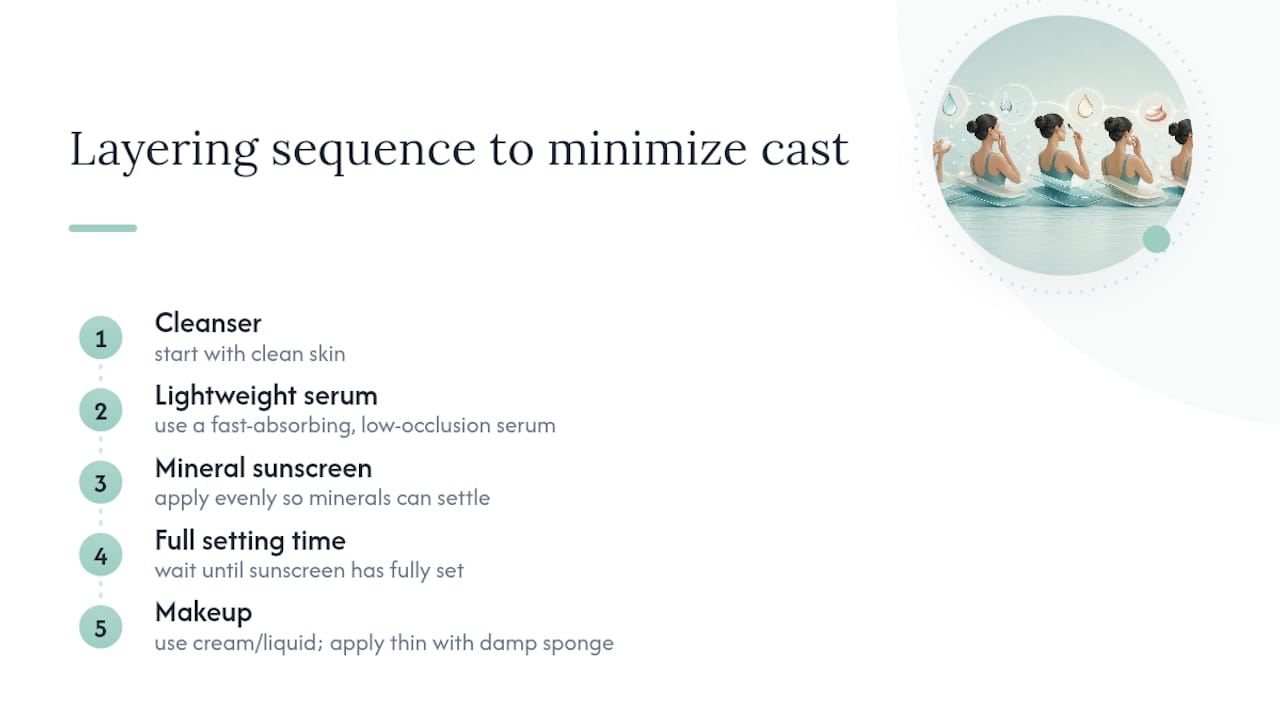
The safest sequence, in most cases, is: cleanser, lightweight serum, mineral sunscreen, then makeup, applied once the sunscreen has fully set. Skipping steps or rushing the setting time is where most visible cast complaints actually originate.
Where Miami Beach Bum® stands on mineral finish
We build reef-safe mineral formulas because they protect skin without the ingredients that harm coral reefs, but a formula only works if people actually enjoy wearing it daily. That’s why cosmetic finish gets the same attention as SPF rating during development. Testing across skin tones and real beach conditions, not just lab swatches, shapes every formula we release.
— Ayssa
Product spotlight: why Blocked SPF50 follows this exact checklist
Everything covered above, tinted formulation, sheer finish, application technique, points toward one practical question: does a product actually deliver on it? Blocked SPF50 was built around that checklist directly. It’s a reef-safe mineral spray formulated to blend down to a sheer finish rather than sitting on skin as a heavy white layer, which matters whether you’re fair-skinned and want zero shine or deep-toned and tired of ashy patches at the beach.
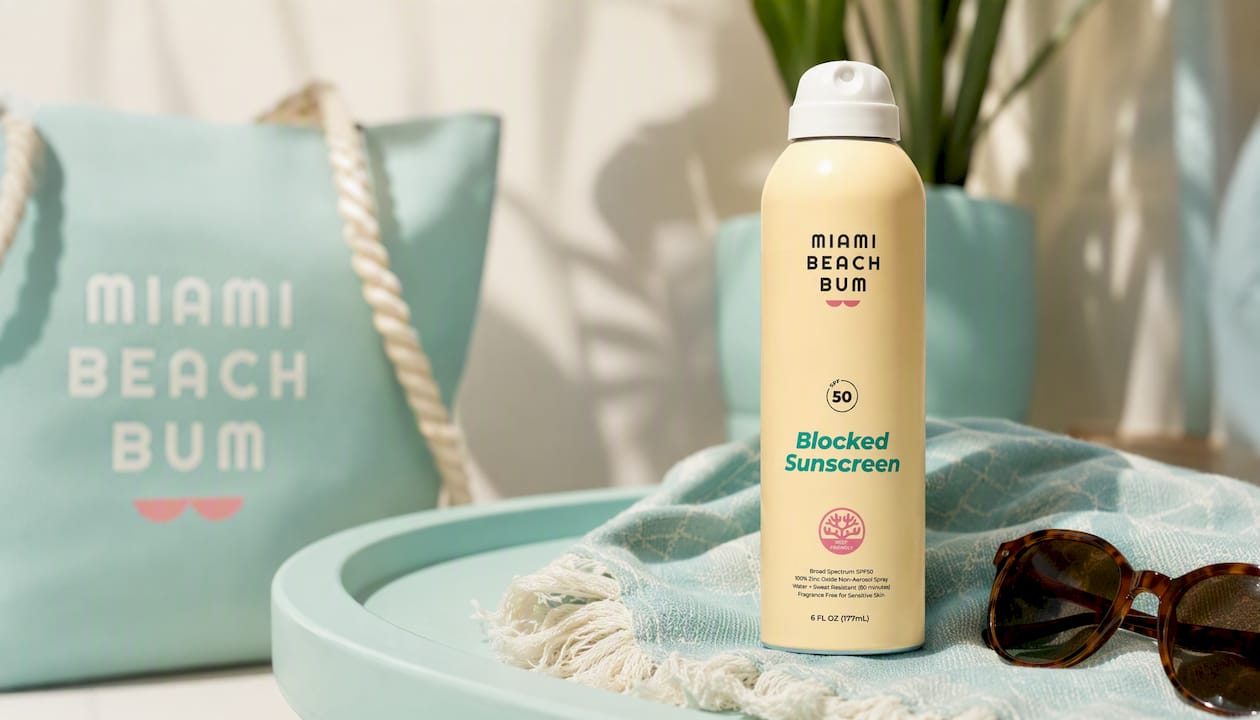
The application tip that matters most with this one: shake it well, spray in a thin, even mist, and rub it in fully before it has a chance to set. Piling on a second coat immediately after the first is the single most common reason any mineral spray looks chalky, and Blocked SPF50 is no exception to that physics. If you’re also using Save Face SPF 50 on your face, apply body spray first and let it settle before moving to the lighter facial serum. Check current stock and bundle pricing on the Blocked SPF50 product page before your next beach trip.
Sources
- A standardized scoring method for measuring white cast of mineral sunscreens and improving user compliance across diverse skin tones — PLOS One
- Mineral sunscreen that reduces white cast developed by UCLA researchers — UCLA Newsroom
- Sunscreen for Darker Skin: How to Avoid a White Cast — WebMD