


Daily broad-spectrum sunscreen prevents new and worsening dark spots by blocking the UV and visible light signals that trigger melanocytes to overproduce melanin. The science is direct: no light stimulus, no excess pigment. Three points to keep in mind before reading further:
- Tinted formulas with iron oxide block visible light, which standard sunscreens miss. This matters most for melasma and post-inflammatory hyperpigmentation (PIH).
- How much you apply and how often you reapply matters as much as the SPF number. Under-application cuts real-world protection significantly.
- Sunscreen supports fading but rarely erases deep pigment on its own. Superficial spots can fade with strict daily use; persistent or hormonal pigment usually needs additional treatment.
Table of Contents
- What dark spots are and what triggers them
- How light exposure triggers dark spots — and where sunscreen interrupts the process
- Which sunscreen features actually matter for preventing dark spots
- How to use sunscreen in a daily pigment-management routine
- What recent studies say about tinted sunscreens and ingredient-augmented formulas
- What sunscreen will and won’t do for existing dark spots
- Key Takeaways
- The case for treating sunscreen as a clinical tool, not a beach accessory
- Miamibeachbum’s reef-safe SPF options for pigment-prone skin
What dark spots are and what triggers them
Dark spots, clinically called hyperpigmentation, form when melanocytes (the pigment-producing cells in the skin’s basal layer) produce more melanin than normal and transfer it into surrounding skin cells via structures called melanosomes. The result is a patch that appears darker than the surrounding skin.
Three subtypes come up most often. Post-inflammatory hyperpigmentation (PIH) follows skin injury or inflammation, such as acne, eczema, or a cut. Solar lentigines (sun spots) develop from cumulative UV exposure and appear most often on the face, chest, and hands. Melasma is driven by a combination of UV exposure, visible light, heat, and hormonal factors, and it tends to be deeper, more diffuse, and harder to treat than PIH.
The distinction between PIH and melasma matters for treatment. PIH is triggered by inflammation and then worsened by light; melasma is primarily driven by light and hormones from the start. Both respond to photoprotection, but melasma requires more aggressive and consistent sun avoidance.
The external triggers you can control are UVA radiation, UVB radiation, visible light (especially high-energy visible light, or HEVL), heat, and inflammation. Hormonal factors (pregnancy, oral contraceptives) are background contributors to melasma that photoprotection cannot fully address, but blocking light still reduces the severity.
Pro Tip: If you have darker skin, do not assume you are naturally protected. Dermatologists consistently note that all Fitzpatrick skin types are susceptible to UV- and visible-light-triggered hyperpigmentation, and darker phototypes often develop more persistent PIH after any inflammatory event.
How light exposure triggers dark spots — and where sunscreen interrupts the process
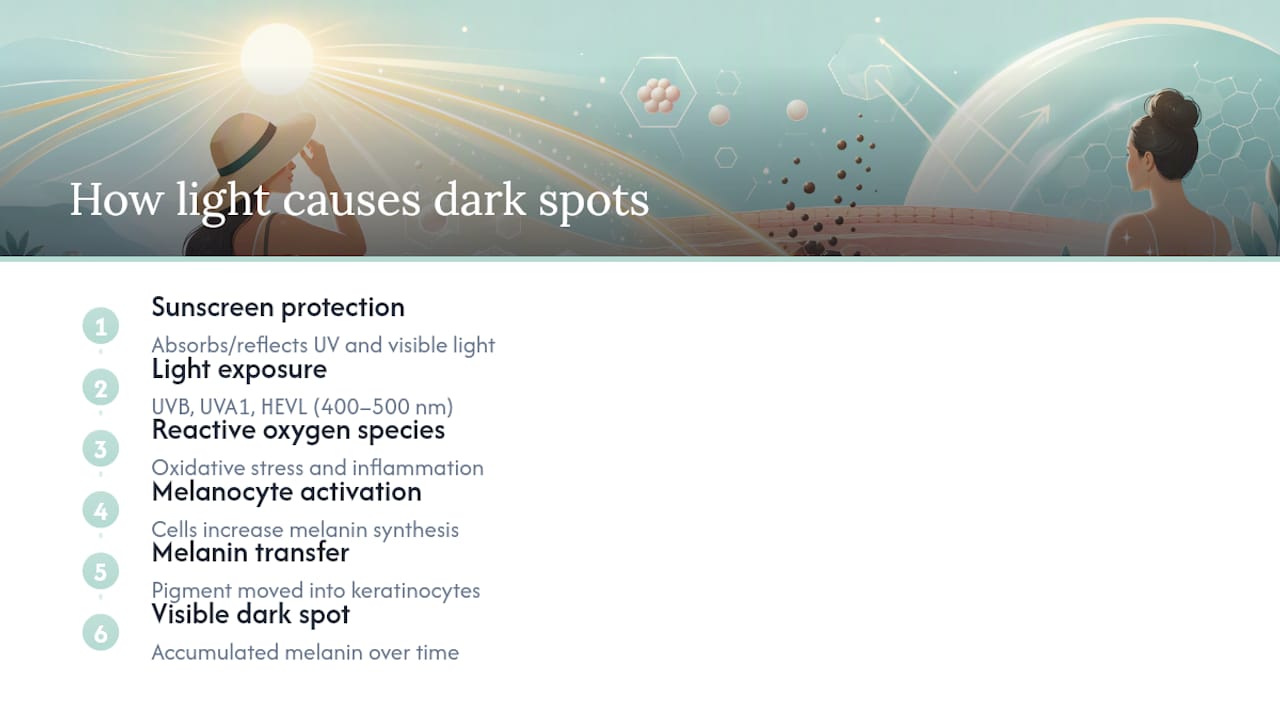
The chain from light to dark spot runs like this: UV or visible light hits the skin, generates reactive oxygen species (free radicals), and triggers oxidative stress and local inflammation. That inflammation activates melanocytes. Activated melanocytes ramp up melanin synthesis and push more pigment into surrounding keratinocytes. Over time, that excess melanin becomes the visible dark spot.
UVB (290–320 nm) is the primary driver of sunburn and directly damages DNA in skin cells, which also stimulates melanin as a protective response. UVA (320–400 nm), especially long-wave UVA1 (340–400 nm), penetrates deeper into the dermis, generates more oxidative stress, and drives the chronic photoaging and pigment changes that accumulate over years. According to research on melasma pathophysiology, UVA1 and visible light are key triggers for melasma and must be addressed by any photoprotection strategy aimed at improving pigmentary outcomes.
Visible light, particularly HEVL in the 400–500 nm range, is where many standard sunscreens fall short. HEVL penetrates deeply and triggers a form of pigment called immediate pigment darkening that can be persistent, especially in skin of color. According to NPR’s reporting on tinted sunscreens, tinted formulas with iron oxide outperform non-tinted sunscreens at preventing visible-light-triggered hyperpigmentation, making them a clinical best practice for melasma and PIH-prone skin.
Sunscreen interrupts this chain at the first step. By absorbing or reflecting light before it reaches the melanocytes, it prevents the oxidative stress and inflammation that set off pigment production. This also means topical brighteners like vitamin C, niacinamide, and azelaic acid work better when sunscreen is used consistently — they are not fighting a daily influx of new pigment signals.
“Sunscreen is not merely cosmetic for people with pigmentary disorders. It functions as an active, preventive therapy and is a foundational component of medical-grade regimens for melasma and PIH.” — Dermatologist consensus, as summarized in clinical photoprotection literature.
The PMC review of sunscreen’s clinical evidence confirms that randomized trials show sunscreen reduces pigmentary alterations and photoaging, supporting its role as a therapeutic tool rather than a cosmetic afterthought. For more on how sunscreen pairs with active skincare ingredients, the SPF and skincare benefits guide covers the interaction in practical detail.
Which sunscreen features actually matter for preventing dark spots
Not every sunscreen on the shelf offers equal protection against hyperpigmentation. These are the label and formulation details that genuinely influence pigment outcomes:
- Broad-spectrum label: Required by the FDA to mean the product protects against both UVA and UVB. This is non-negotiable for pigment prevention.
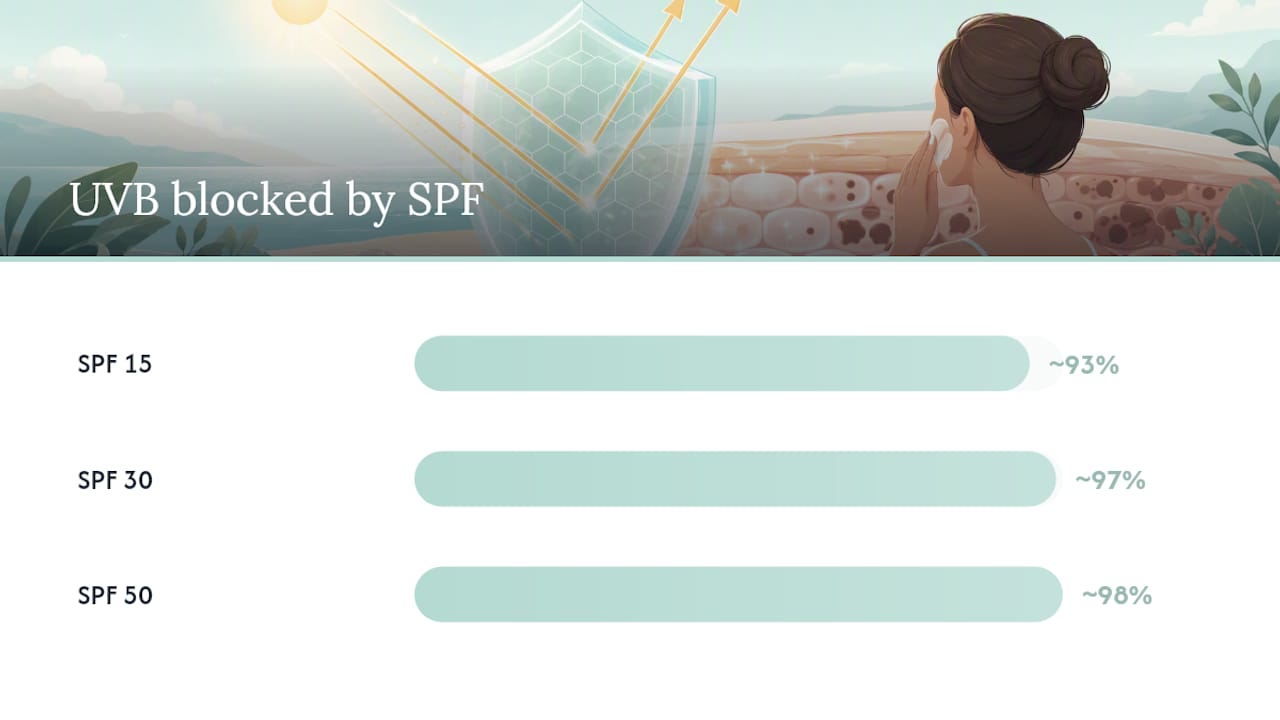
- SPF 30–50 for daily use: Stanford Medicine’s sunscreen science resource notes that SPF 15 blocks approximately 93% of UVB, SPF 30 blocks approximately 97%, and SPF 50 blocks approximately 98%. The jump from SPF 30 to SPF 50 is modest, but SPF 50 provides a useful buffer for people who under-apply.
- Iron oxide (tinted formulas): The AAD guidance on fading dark spots notes that iron oxide is listed as an inactive ingredient because it does not protect against UV — but it meaningfully protects against visible light. Check the inactive ingredient list, not just the active filters, to confirm visible-light coverage.
- Photostable filters: Some UV filters degrade in sunlight and lose efficacy. Zinc oxide and titanium dioxide (mineral filters) are inherently photostable. Among chemical filters, look for avobenzone stabilized with octocrylene or bemotrizinol.
- Water resistance: Relevant for outdoor activity or sweating. Labels must state either 40 or 80 minutes of water resistance per FDA rules.
- Cosmetic acceptability: The best sunscreen is the one you will actually wear every day. Finish, texture, and tint shade all affect compliance.
| SPF Level | UVB Blocked | Practical Use Case |
|---|---|---|
| SPF 15 | ~93% | Minimal incidental indoor exposure only |
| SPF 30 | ~97% | Daily use, standard outdoor activity |
| SPF 50 | ~98% | Recommended for pigment-prone skin and for prolonged high-UV outdoor exposure; buffers under-application |
Pro Tip: If you are managing melasma or PIH, look for “tinted” or “with iron oxide” on the label and confirm iron oxide appears in the inactive ingredients. A clear SPF 50 does not protect against the visible light that can worsen both conditions.
For a detailed comparison of mineral and chemical filter options, the chemical vs. mineral sunscreen guide covers the tradeoffs for sensitive and acne-prone skin.
How to use sunscreen in a daily pigment-management routine
Getting the biology right matters less if the application is wrong. Here is a practical, step-by-step approach:
- Apply the right amount. SkinCancer.org notes that SPF testing uses a standard of 2 mg/cm², which works out to roughly half a teaspoon for the face and neck. Most people apply far less, which drops real-world protection well below the labeled SPF. For the body, use about one ounce (a shot glass full) per full application.
- Apply before sun exposure. Chemical sunscreens need about 15 minutes to bind to skin before they are fully active. Mineral sunscreens work on contact, but applying early builds the habit.
- Layer correctly in the morning. A practical order: cleanse, apply an antioxidant serum (vitamin C is a strong complement to sunscreen for oxidative stress), then apply broad-spectrum sunscreen, then tint or foundation if used. Sunscreen goes on skin, not over makeup.
- Combine safely with depigmenting actives. Retinoids, azelaic acid, niacinamide, and prescription hydroquinone are all used at night or under sunscreen in the morning. Retinoids increase photosensitivity, making daily sunscreen non-negotiable. Avoid layering multiple exfoliating acids under sunscreen on the same morning. For common layering mistakes, the skincare and sunscreen combo mistakes guide is a useful reference.
- Reapply every two hours in direct sun. For incidental indoor exposure (commuting, sitting near windows), one morning application is generally adequate. For prolonged outdoor time, reapply every two hours and after swimming or heavy sweating.
- Use practical tools for reapplication. A travel-size sunscreen or a setting spray with SPF makes midday reapplication realistic. Powder sunscreens can go over makeup without disrupting it.
- Add physical barriers. Sunscreen alone is not a complete strategy. Wide-brim hats, UPF-rated clothing, and shade between 10 AM and 4 PM reduce total UV and visible-light load, which matters most for melasma.
What recent studies say about tinted sunscreens and ingredient-augmented formulas
The evidence base for tinted sunscreens and sunscreens with active ingredients has grown considerably in recent years.
A randomized, investigator-blinded trial tested a broad-spectrum sunscreen containing sclareolide (an anti-inflammatory derived from clary sage) and niacinamide in participants with Fitzpatrick skin types IV–V. After combined UV and visible-light exposure, protected areas improved by +5.96 ΔITA° (a measure of skin lightness) while unprotected areas worsened by -9.88 ΔITA°, a net protection difference of approximately 16 ITA° (p < 0.001). Secondary endpoints including colorimetry and clinical grading improved by 48–87% in protected areas.
| Outcome Measure | Protected Area | Unprotected Area |
|---|---|---|
| ΔITA° (skin lightness change) | +5.96 | -9.88 |
| Net protection difference | ~16 ITA° (p < 0.001) | — |
| Secondary endpoint improvement | 48–87% | Worsened |
Key findings from the broader evidence base:
- Tinted sunscreens with iron oxide block visible light that standard broad-spectrum formulas miss, making them the preferred option for melasma and PIH-prone skin per NPR’s reporting on dermatologist recommendations.
- The melasma photoprotection review identifies UVA1 and visible light as the primary drivers of melasma recurrence and calls for photoprotection that specifically addresses these wavelengths.
- Dermatologists increasingly frame tinted sunscreen as a clinical standard of care for pigment disorders, not a cosmetic preference.
- Study populations in pigment trials are often small, and results in lighter phototypes may differ. Ongoing research continues to refine optimal iron oxide concentrations and filter combinations.
What sunscreen will and won’t do for existing dark spots
Sunscreen prevents new pigment from forming and stops existing spots from darkening further. That is its primary job. What it does not do is actively bleach or resurface skin.
Realistic timelines:
- Prevention is immediate from the first day of consistent use.
- Superficial PIH (epidermal layer only) can begin to fade in 6–12 weeks with strict daily sunscreen use, because normal cell turnover gradually replaces pigmented cells when no new stimulus is added.
- Solar lentigines fade more slowly, often over several months, and may require topical agents (niacinamide, alpha arbutin, kojic acid) or in-office procedures (chemical peels, laser) for meaningful improvement.
- Melasma, especially dermal melasma, often requires a combination of strict photoprotection, prescription topicals (hydroquinone, tretinoin, azelaic acid), and professional treatments. Sunscreen alone rarely resolves it.
Signs it is time to see a dermatologist:
- A spot changes shape, color, or border rapidly (rule out melanoma first).
- You cannot confidently distinguish a dark spot from a mole or lesion.
- Pigment does not respond after 3–6 months of strict daily broad-spectrum sunscreen plus a topical brightener.
- Melasma is worsening despite consistent photoprotection.
The sunscreen benefits overview covers the broader skin-health case for daily SPF beyond pigmentation.
Key Takeaways
Daily broad-spectrum sunscreen, applied correctly and consistently, is the single most effective step for preventing new dark spots and stopping existing ones from worsening.
| Point | Details |
|---|---|
| Block all light types | Use a broad-spectrum SPF 30–50 daily; add a tinted formula with iron oxide to block visible light for melasma and PIH. |
| Apply enough | Half a teaspoon for face and neck; one ounce for the body. Under-application cuts real-world SPF significantly. |
| Reapply consistently | Every two hours in direct sun, and after swimming or sweating. One morning application covers incidental indoor exposure. |
| Set realistic expectations | Superficial PIH may fade in 6–12 weeks; deeper melasma usually needs topical agents or procedures alongside sunscreen. |
| Miamibeachbum’s approach | Miamibeachbum’s Save Face SPF 50 Sheer Mineral Facial Serum offers daily mineral protection for pigment-prone skin. |
The case for treating sunscreen as a clinical tool, not a beach accessory
Most people reach for sunscreen when they are heading outside for the day. The science says that framing is the problem. The UV and visible light that drive hyperpigmentation accumulate on ordinary days: the commute, the window seat, the ten minutes walking to lunch. Melasma in particular is notoriously sensitive to even low-level visible-light exposure, which is why dermatologists increasingly recommend tinted sunscreen year-round, indoors included.
The other thing that gets underestimated is the ingredient list. Iron oxide appears in the inactive section of a sunscreen label because the FDA’s active-ingredient category covers only UV filters. That placement makes it easy to overlook, but it is doing real work against the visible-light wavelengths that standard filters cannot touch. Checking the inactive ingredients is not a niche move for skincare enthusiasts. For anyone managing melasma or PIH, it is the difference between a sunscreen that addresses the full trigger spectrum and one that leaves a gap.
Sunscreen formulated with anti-inflammatory actives like niacinamide and sclareolide adds another layer. The randomized trial data showing a ~16 ITA° protection difference is not a marginal finding. It suggests that the formulation around the SPF filters matters, not just the SPF number itself.
The honest bottom line: sunscreen is the foundation, not the whole structure. Pair it with shade, protective clothing, and targeted topicals for the best outcome. But without consistent daily photoprotection, everything else in a pigment-management plan is working against a headwind.
Miamibeachbum’s reef-safe SPF options for pigment-prone skin
Miamibeachbum’s Save Face SPF 50 Sheer Mineral Facial Serum is built for daily use on pigment-prone skin. It uses mineral filters (zinc oxide and titanium dioxide) that are inherently photostable and reef-safe, making it a practical choice for consistent everyday wear. Mineral formulas sit on the skin’s surface rather than absorbing into it, which suits sensitive or reactive skin types prone to PIH.
For body coverage, the Bum + Body collection pairs sun protection with skin-barrier support. Sunscreen is one part of a complete pigment-management plan; the rest involves topical actives, reapplication habits, and, when needed, professional care. Browse the Save Face serum to see the full ingredient list and find the right daily SPF for your routine.