


Sunscreen is not broadly “bad.” The evidence is clear: properly applied sunscreen reduces the risk of skin cancer and photoaging. So why does the negative reputation persist? Three factors drive most of it: the FDA’s OTC drug classification slows approval of new UV filters, leaving the U.S. with 17 approved filters compared to roughly 30 in the EU; a 2021 wave of recalls found benzene contamination in specific spray sunscreen lots; and social media amplifies isolated concerns into broad distrust. None of these facts make sunscreen dangerous as a category.
Quick actions you can take now:
- Choose a broad-spectrum sunscreen labeled SPF of at least 30
- Reapply regularly according to usage guidelines, especially after swimming or sweating
- If you have sensitive skin, try a mineral formula with zinc oxide or titanium dioxide
- Ignore SPF-in-makeup as your only protection; it rarely provides adequate coverage
- Consult a dermatologist if you have specific allergies or skin conditions
Table of Contents
- Why sunscreen gets a bad reputation: the real reasons
- Sunscreen myths debunked with evidence
- How sunscreen works and what labels actually mean
- What the science says about safety
- Why the U.S. has fewer approved UV filters than the EU
- Why the negative reputation sticks
- How to pick, apply, and use sunscreen effectively
- Key Takeaways
- The case for staying evidence-first on sun care
- Sun care that starts with the science
- Sources and further reading
Why sunscreen gets a bad reputation: the real reasons
People who say “sunscreen is bad” are usually describing several different problems at once. Separating those complaints makes it easier to evaluate each one on its own merits.
Common complaints and what they actually mean:
- Chemical toxicity / hormone disruption: Concerns center on oxybenzone and a few other organic filters. The evidence comes mostly from animal studies using doses far above real-world exposure.
- Cancer risk: Some viral posts claim sunscreen users have higher skin cancer rates. This is a correlation-causation error; people who use sunscreen often spend more time in high-UV environments.
- Vitamin D deficiency: The claim is that sunscreen blocks all UV-B, cutting off vitamin D synthesis. In practice, typical application patterns leave enough UV exposure for most people.
- Allergic or irritation reactions: Real, but uncommon. Specific ingredients (fragrance, oxybenzone) cause reactions in a small subset of users.
- Cosmetic issues: White cast, greasy texture, and scent are legitimate product complaints that drive non-use, especially among people with deeper skin tones.
- Environmental harm: Reef-safe concerns are real for certain ingredients in specific marine ecosystems, though real-world concentrations are usually far below lab-effect thresholds.
- Regulatory distrust: The benzene recalls and the EU-vs.-U.S. filter gap fuel a sense that regulators are either asleep or captured by industry.
Some of these complaints are narrow and product-specific. Others reflect genuine systemic issues with how sunscreen is regulated and marketed. The sections below address each with the available evidence.
Sunscreen myths debunked with evidence
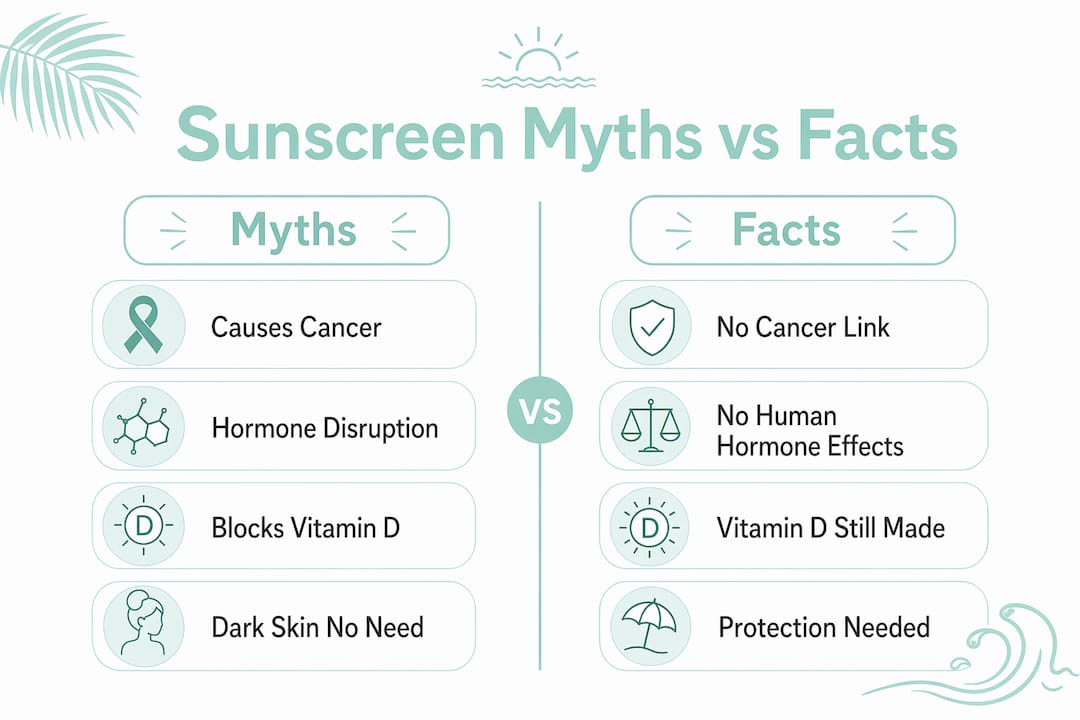
Myth 1: Sunscreen causes cancer
False. Studies showing higher cancer rates among sunscreen users were observational and ignored a critical confounder: people who use sunscreen also tend to spend more time outdoors in high-UV settings. Detailed analyses of viral posts making this claim found the graphs omitted behavioral factors like sun-seeking habits and travel patterns entirely. UV exposure is the established driver of skin cancer, not the product people use to reduce it.

Myth 2: Sunscreen causes hormone disruption
Unsupported in humans. Oxybenzone draws the most attention here. According to a 2017 study in the Journal of the American Academy of Dermatology, it would take 277 years of sunscreen use to reach the systemic dose that produced hormonal effects in rat studies. The organizations raising concerns cite those rat studies, where rats were fed oxybenzone, not exposed to it topically. No conclusive evidence of harm in humans exists at real-world use levels.
Myth 3: Sunscreen blocks vitamin D completely
Not accurate. Dermatology experts confirm that typical sunscreen application patterns do not eliminate all UV-B exposure. Most people apply less than the tested amount, and no one covers every exposed surface perfectly. Population-level vitamin D deficiency is not driven primarily by sunscreen use.

Myth 4: People with dark skin don’t need sunscreen
Incorrect. Melanin does provide some natural UV protection, but it does not prevent UV damage, photoaging, or skin cancer. Dermatologists recommend broad-spectrum sunscreen for all skin tones.
Myth 5: High SPF means you’re protected all day
Wrong. SPF measures protection against a single, controlled UV dose, not duration. No sunscreen, regardless of SPF, lasts all day without reapplication. SPF 50 blocks about 98% of UV-B rays; SPF 100 blocks about 99%. The difference is small. Reapplication matters far more than chasing a higher number.
Myth 6: Sunscreen makes you complacent and increases sun exposure
Partly true, and worth taking seriously. Harvard Medical School dermatologist Dr. Jennifer Lin notes that studies have shown people who apply sunscreen tend to stay outdoors longer, which can increase total UV exposure. The solution is not to skip sunscreen; it is to combine sunscreen with shade, protective clothing, and timed outdoor activity.
Myth 7: Homemade or “natural” sunscreen substitutes are safe
They are not. Coconut oil has an SPF of roughly 4–7, which provides negligible protection. Influencers recommending DIY formulas or extreme sunlight exposure lack clinical evidence for their claims, and dermatologists consistently warn these approaches are risky.
“Many studies have demonstrated that individuals who use sunscreen tend to stay out in the sun for a longer period of time, and thus may actually increase their risk of skin cancer. There’s a danger in assuming that putting on sunscreen is by itself enough to protect you against the sun.” — Dr. Jennifer Lin, Harvard Medical School / Brigham and Women’s Hospital
Pro Tip: The benzene recalls in 2021 were real, but they affected specific spray lots, not all sunscreen products. Checking the FDA’s recall database for your specific product is more useful than avoiding sunscreen as a category.
How sunscreen works and what labels actually mean
All effective sunscreens reduce the UV radiation that reaches your skin. The difference between product types is in the filter chemistry and how the formula feels on skin.
Organic (often called “chemical”) filters absorb UV energy and convert it to heat, which dissipates from the skin. Common examples include avobenzone, octinoxate, and oxybenzone. They tend to be lighter in texture and invisible on skin, which makes them popular for daily use.
Inorganic (“mineral” or “physical”) filters work primarily by scattering and absorbing UV. Zinc oxide and titanium dioxide are the only two approved in the U.S. They sit on the skin surface rather than being absorbed, and they can leave a white cast, particularly in older formulations. Micronized (nanoparticle) versions reduce the cast significantly. Nanoparticles have not been shown to penetrate beyond the outer skin layer into the bloodstream, so the systemic risk concern does not hold up under current evidence.
The chemical vs. mineral distinction is often framed as “toxic vs. clean” in marketing, but experts stress that cosmetic differences are real while the toxicity framing is not supported by human data. Both filter types protect. Your choice should come down to skin type, texture preference, and how you plan to use the product.
Key label terms to know:
- Broad-spectrum: Protects against both UV-A and UV-B rays. Required by the FDA for any SPF 15+ product making skin-cancer protection claims.
- SPF number: Measures UV-B protection only. SPF 30 blocks about 97% of UV-B; SPF 50 blocks about 98%.
- Water resistant (40 min / 80 min): Tells you how long protection lasts during water exposure before reapplication is needed. No sunscreen is truly “waterproof.”
- Mineral / physical: Contains only zinc oxide and/or titanium dioxide as active ingredients.
Pro Tip: To read a label quickly, go straight to the “Active Ingredients” section. If you see only zinc oxide and/or titanium dioxide, it is a mineral formula. Everything else is an organic filter. The rest of the label is marketing.
What the science says about safety
Current human evidence does not show that sunscreen causes cancer or hormone problems at real-world use levels. Occasional allergic reactions are possible. Environmental questions remain active, but real-world concentrations are usually far below the thresholds where lab effects appear.
| Concern | Evidence level | Practical implication |
|---|---|---|
| Causes skin cancer | Not supported; correlation studies confounded by behavior | Continue using sunscreen; combine with shade and clothing |
| Hormone disruption (oxybenzone) | Animal/lab signals; no conclusive human evidence at real-world doses | Choose a mineral formula if concerned; do not skip sunscreen |
| Vitamin D deficiency | Not supported at population level; typical use leaves UV-B exposure | Maintain sunscreen use; discuss vitamin D with a doctor if deficient |
| Nanoparticle systemic absorption | Not shown to penetrate beyond outer skin layer | Mineral sunscreens with nanoparticles are considered safe for topical use |
| Allergic / irritation reactions | Real but uncommon; specific ingredients (fragrance, oxybenzone) are triggers | Patch test; switch to fragrance-free or mineral formulas if reactive |
| Reef and marine ecosystem harm | Active research area; oxybenzone and octinoxate restricted in some jurisdictions | Choose reef-safe formulas in marine environments; Hawaii and some U.S. territories have restrictions |
| Benzene contamination | Isolated to specific lots in 2021 recalls; not a category-wide issue | Check FDA recall database for your specific product |
Animal and high-dose lab studies use exposures orders of magnitude above typical human application. Those experimental conditions cannot be directly equated with everyday sunscreen use. The FDA, the American Academy of Dermatology, and the CDC all maintain that the benefits of sunscreen use outweigh the theoretical risks identified in non-human studies.
Regarding environmental impact: oxybenzone and octinoxate have been shown to affect coral larvae in lab settings, and Hawaii banned both in 2021. Real-world ocean concentrations vary widely, and the research is ongoing. Bioaccumulation in marine organisms is an active area of study. For coastal and reef environments, mineral formulas with zinc oxide are the more cautious choice.
For children and pregnant women, mineral sunscreens are generally the preferred recommendation because they avoid the organic filters where theoretical concerns exist, even if those concerns are not confirmed in humans. The FDA has not declared any sunscreen ingredient unsafe for these groups, but the precautionary logic is reasonable.
Why the U.S. has fewer approved UV filters than the EU
The FDA classifies sunscreens as over-the-counter (OTC) drugs, not cosmetics. That classification means any new UV filter must go through a formal drug-approval process, which takes years and significant investment. The EU classifies sunscreens as cosmetics, which allows new filters to reach market faster under a different regulatory framework.
The result: the U.S. has 17 FDA-approved UV filters while the EU has access to roughly 30. Filters like Tinosorb S, Tinosorb M, Mexoryl SX, and Uvinul A Plus are available in European products but not in the U.S. Some of these offer better UV-A coverage or greater photostability than older U.S.-approved filters.
| Market | Approved UV filters | Examples not available in the other market |
|---|---|---|
| United States | 17 | — |
| European Union | about 30 | Tinosorb S, Tinosorb M, Mexoryl SX, Uvinul A Plus |
This gap does not mean U.S. sunscreens are unsafe. It means the protection profile can differ, particularly for UV-A coverage. Broad-spectrum U.S. products still provide meaningful protection. The regulatory barriers also shape which U.S.-made alternatives reach consumers, which is worth understanding when comparing domestic and imported products.
Pro Tip: When shopping U.S. sunscreens, prioritize “broad-spectrum” on the label and look for avobenzone (at 3%) or zinc oxide as the UV-A filter. Those are the strongest UV-A options currently available in U.S. formulations.
Why the negative reputation sticks
A few real events and many amplified misunderstandings combine to keep sunscreen’s reputation under pressure.
- Viral misinformation: An analysis of 971 TikTok videos about sunscreen found that negative or misleading content generated higher engagement despite representing a small share of total posts. Algorithms reward shock value over accuracy.
- Influencer narratives: Investigations document influencers recommending sunlight extremes or DIY substitutes, framing ancestral sun exposure as healthier than modern photoprotection. Dermatologists consistently describe these claims as unsupported and risky.
- “Clean beauty” marketing: Brands that label organic filters as “toxic” and mineral filters as “clean” oversimplify a complex chemistry question into a moral binary. That framing sticks because it is simple and emotionally resonant.
- Correlation-causation errors: Misleading viral posts omit behavioral confounders; people who use sunscreen often spend more time in high-UV settings, which makes raw comparisons look like sunscreen causes harm.
- Real product events: The 2021 benzene recalls were legitimate safety events. They affected specific lots, not the category, but they gave anti-sunscreen narratives a factual anchor that gets reused out of context.
- Cosmetic complaints: White cast, greasiness, and scent are real barriers to use. When a product feels unpleasant, people stop using it and sometimes rationalize that decision with safety concerns they read online.
- Institutional skepticism: Broader distrust of the FDA and pharmaceutical industry makes regulatory reassurances less effective for some audiences, even when the evidence is solid.
Major health organizations and national cancer advocates have flagged sunscreen misinformation as a growing public-health concern, precisely because abandoning sunscreen increases measurable skin damage and cancer risk.
How to pick, apply, and use sunscreen effectively
Choose broad-spectrum SPF 30 or higher for everyday use, SPF 50 for prolonged outdoor exposure. If you have sensitive skin, patch test on your inner arm before full application. Reapply regularly according to usage guidelines, especially after swimming or sweating.
Checklist for picking a sunscreen:
- Broad-spectrum label: Non-negotiable. This confirms UV-A and UV-B coverage.
- SPF 30 minimum: SPF 30 for daily use; SPF 50 for beach, sport, or extended outdoor activity.
- Formulation match: Oily or acne-prone skin often does better with lightweight organic filters. Sensitive or reactive skin usually tolerates mineral formulas better.
- Water resistance: Choose 80-minute water resistance for swimming or heavy sweating.
- Fragrance-free: If you have a history of skin reactions, fragrance is a common trigger.
- Reef-safe: If you swim in coral reef environments, choose a formula with zinc oxide or titanium dioxide and without oxybenzone or octinoxate.
- Expiration date: Sunscreen degrades. An expired product may not provide its labeled SPF.
Application amounts matter. For the body, use roughly one ounce (a shot glass full) to cover exposed skin. For the face, a nickel-sized amount is the standard recommendation. Most people apply 25–50% of the amount needed to achieve the labeled SPF. Under-application is one of the most common reasons sunscreen underperforms.
SPF in makeup rarely provides adequate protection on its own. Foundation with SPF 15 applied in a thin layer delivers far less than SPF 15 in practice. Use a dedicated sunscreen underneath and treat the makeup SPF as a minor bonus, not a substitute.
For texture concerns, jelly sunscreen formulas offer a lighter, less greasy feel that works well for active use. Tinted mineral sunscreens reduce white cast while adding a slight color correction benefit.
Pro Tip: To minimize white cast from mineral sunscreen, apply a thin layer, let it absorb for 60 seconds, then blend with a damp beauty sponge. The cast reduces significantly without compromising coverage.
Key Takeaways
Sunscreen prevents skin cancer and photoaging; the safety concerns circulating online are either isolated product events or unsupported in human data at real-world use levels.
| Point | Details |
|---|---|
| Sunscreen prevents skin cancer | UV exposure is the proven cause; sunscreen reduces that exposure when applied correctly and consistently. |
| Safety concerns are narrow or theoretical | Hormone disruption evidence comes from animal studies using doses far above real-world use; benzene recalls affected specific lots, not the whole category. |
| Application amount and reapplication matter | Use one ounce for the body, reapply every two hours; under-application is the most common reason sunscreen underperforms. |
| U.S. has fewer approved filters than the EU | The FDA’s OTC drug classification limits the U.S. to 17 approved filters versus about 30 in the EU; broad-spectrum coverage remains achievable. |
| Miamibeachbum offers evidence-based sun care | Miamibeachbum’s Save Face SPF 50 Sheer Mineral Facial Serum is a sheer mineral option for readers who want effective, low-irritation protection. |
The case for staying evidence-first on sun care
The anti-sunscreen narrative is not random. It taps into real institutional skepticism, genuine cosmetic frustrations, and a few legitimate product safety events. That combination makes it persuasive, even when the underlying claims do not hold up under scrutiny.
What gets lost in the noise is proportion. The evidence for UV radiation as a cause of skin cancer is extensive and consistent. The evidence that sunscreen, used as directed, causes comparable harm is not. Treating those two bodies of evidence as equivalent is not skepticism; it is a false balance that carries real health consequences.
The more useful question is not “is sunscreen safe?” but “which formula works for my skin, my lifestyle, and my environment?” That is a solvable problem. Mineral formulas address most ingredient concerns. Fragrance-free options reduce irritation risk. Reef-safe formulas handle the environmental question in marine settings. The category has answers for nearly every complaint, if the conversation stays grounded in what the evidence actually shows.
Consulting a dermatologist for personalized guidance remains the most reliable path for anyone with specific allergies, skin conditions, or concerns about particular ingredients.
Sun care that starts with the science
Miamibeachbum was built around one idea: sun care should be grounded in evidence, not marketing trends. For readers who want a sheer mineral option that sidesteps the organic-filter debate entirely, the Save Face SPF 50 Sheer Mineral Facial Serum delivers broad-spectrum UV-A and UV-B protection in a lightweight, non-whitening formula designed for daily use.
If you want to explore the full range of body care built on the same standard, the Bum + Body collection covers skin from head to toe. For first-time buyers, the Bodycare Discovery Set lets you test formulas before committing to a full size. Every product reflects Miamibeachbum’s commitment to clear ingredients, honest SPF claims, and sun care that actually works.
Sources and further reading
Official guidance and medical organizations:
- FDA: Sunscreen — How to Help Protect Your Skin from the Sun
- Harvard Health: The Science of Sunscreen
- Healio Dermatology: Debunking Common Sunscreen Myths
Long-form explainers and investigations:
- Stanford Medicine: Sunscreen Fact and Fiction
- Undark: Anti-Sunscreen Movement Analysis
- Annie Lab: Viral Post Misleadingly Links Sunscreen Use to Higher Cancer Risk
- The Independent: Influencers Telling Us Not to Wear Sunscreen
- Deseret News: TikTok Videos About Sunscreen Spread Misinformation
- BBC Future: Mineral vs. Chemical Sunscreen
- The Globe and Mail: Anti-Sunscreen Misinformation and Skin Cancer Advocates
Practical label-reading and product guidance:
- Miamibeachbum: How to Read a Sunscreen Label
- Miamibeachbum: Chemical vs. Mineral Sunscreen
- Enriched Med Spa: The Importance of Sunscreen
This article is general information, not medical advice. Consult a dermatologist for guidance specific to your skin type, health history, or ingredient concerns.