


Picaridin is the better default for everyday family and outdoor use. It matches DEET’s protection against mosquitoes and ticks, feels lighter on skin, and won’t eat through your sunglasses. DEET still earns its place in high disease-risk zones, where its decades-long track record makes it the more conservative pick. Both are EPA-registered and safe when you follow the label, and a family-friendly option like Totally Buggin’ fits squarely into the picaridin camp.
TL;DR:
- Both picaridin and DEET offer similar protection durations when used at appropriate concentrations, with no significant difference in effectiveness against mosquitoes and ticks.
- Picaridin typically causes fewer skin irritations and is less greasy or odorous, improving user compliance and reapplication frequency.
- DEET has a longer history of research and proven performance in high disease-risk regions, making it the more conservative choice for travel to endemic areas.
- Higher concentrations of either ingredient extend protection time, but benefits diminish beyond 30 to 50 percent, making mid-range formulations most practical.
- Proper application, coverage, and reapplication schedules are more critical to effectiveness than the specific repellent ingredient used.
Table of Contents
- Picaridin vs DEET: A Side-by-Side Comparison
- What Do Studies and Agencies Actually Say About Effectiveness?
- Is Picaridin Safe for Kids and Pregnant Women?
- How to Apply and Reapply Repellent the Right Way
- Which One Is Gentler on Gear and Skin?
- Which Repellent Should You Pack for Your Situation?
- Why We Weigh the Evidence This Way
- What Actually Matters Once You Get Past the Ingredient Debate
- Meet Totally Buggin’, a Repellent Built for Real Family Days
- Sources
Picaridin vs DEET: A Side-by-Side Comparison
Here’s how the two ingredients stack up on the factors that actually change your decision at the trailhead or the pool deck.
- Effectiveness (mosquitoes, ticks, flies): Comparative studies find little meaningful gap in protection between picaridin and DEET at equivalent concentrations, with species-specific variation showing up in lab assays more than real-world use.
- Protection duration: Higher concentrations extend protection time for both ingredients; the CDC notes that correct, even application matters more than which one you choose.
- Skin tolerability: Picaridin causes fewer reports of skin irritation and rarely leaves a sticky residue; DEET can sting broken skin or feel heavy after a few reapplications.
- Material compatibility: DEET can degrade plastics, rayon, spandex, and vinyl. Picaridin is generally safe on synthetics, sunglasses frames, and watch bands.
- Child safety: Both are permitted for children per label instructions, with no ingredient uniquely restricted for kids over two months.
- User experience: Picaridin is nearly odorless and non-greasy, which the REI expert guide links to better long-term compliance among frequent users.
Best for picaridin: daily wear, kids, gear-heavy trips, sensitive skin. Best for DEET: backcountry travel or regions with serious mosquito-borne disease risk, where its longer track record still carries weight.
What Do Studies and Agencies Actually Say About Effectiveness?
Peer-reviewed comparisons keep landing in the same place: picaridin performs on par with DEET, and in some formulations edges it out slightly. A widely cited comparative review indexed on PubMed found no significant difference in protection duration between equivalent doses of the two, a finding consistent with picaridin’s decades of use across Europe and Australia before it reached U.S. shelves in the early 2000s. That history matters. Picaridin isn’t a novel or under-tested chemical, it’s a mainstream repellent that took longer to arrive in American stores than it did to prove itself abroad.
Species matters more than most people realize. The National Pesticide Information Center documents that both DEET and picaridin repel mosquitoes, ticks, chiggers, and biting flies, but laboratory assays show performance shifts depending on which species is tested and how the product is formulated. A spray that dominates against Aedes mosquitoes in one trial might show a smaller edge against Anopheles in another. This is why blanket claims that one ingredient is “the most effective” don’t hold up. Effectiveness is not one number, it’s a range shaped by species, formulation, humidity, and how much you sweat.
Concentration drives duration more than ingredient choice does. The CDC’s Yellow Book and EPA guidance both note that higher concentrations of either active ingredient extend protection time, but DEET’s efficacy tends to plateau past roughly 30 to 50%. Buying a 100% DEET product doesn’t buy you proportionally more hours outdoors, it mostly buys you a stronger smell and a higher chance of skin irritation. Picaridin follows a similar diminishing-returns curve, which is why most consumer formulations sit in the 10 to 20% range rather than pushing toward extremes.
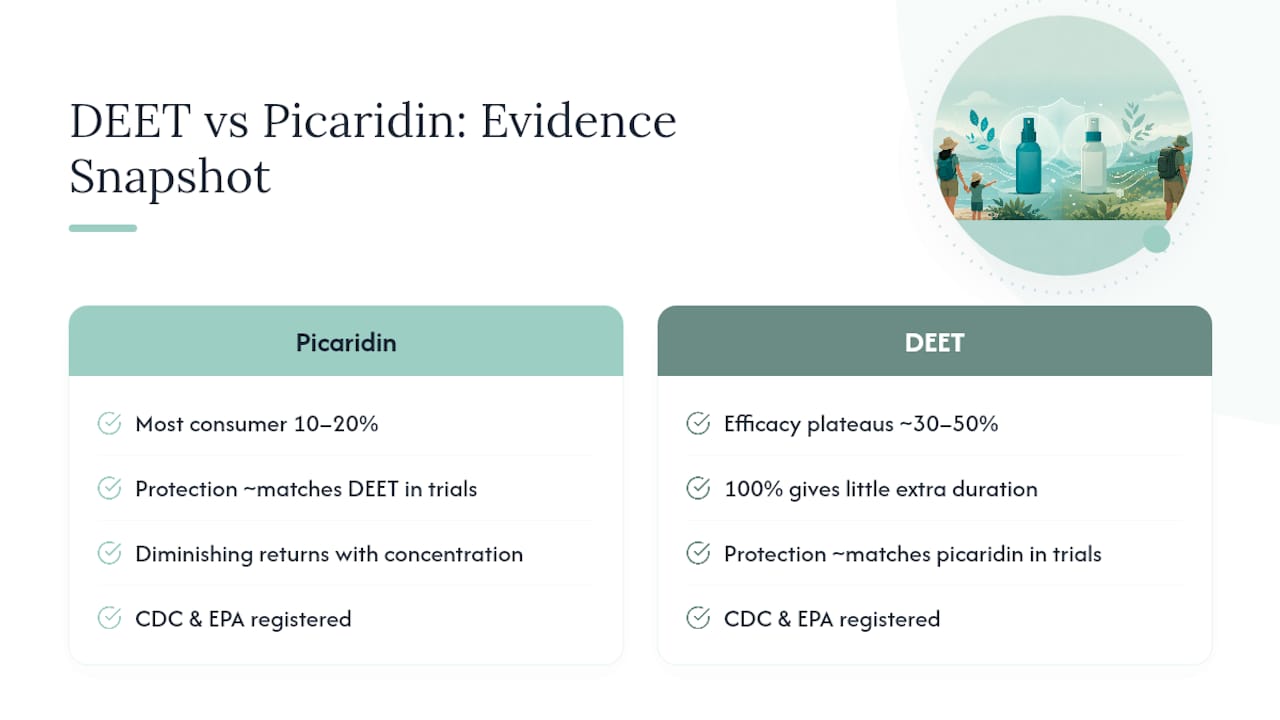
The regulatory picture backs up the practical one. Both DEET and picaridin sit on the CDC’s and EPA’s list of registered conventional repellents recommended for protection against mosquito and tick-borne disease. Neither agency ranks one as universally superior. Instead, both stress that correct application, full skin coverage, even spraying, and reapplication on schedule, changes outcomes more than the specific active ingredient on the label. That’s a less flashy conclusion than “ingredient X wins,” but it’s the one the evidence actually supports. A carefully applied 10% picaridin lotion will usually outperform a sloppily applied 100% DEET spray, simply because it gets on the skin it needs to cover.
Where DEET still holds an edge is breadth of data. It has been studied for longer, across more geographies and more disease vectors, than picaridin has. That doesn’t make picaridin unproven, it makes DEET the deeper-studied of two options that already perform similarly in the trials that exist.
Is Picaridin Safe for Kids and Pregnant Women?
Both ingredients are considered safe for most people, including children and pregnant or breastfeeding women, when used exactly as labeled. The EPA’s picaridin fact sheet reports low acute toxicity and states picaridin is unlikely to present a health concern under labeled use. DEET carries a similarly long safety record when applied correctly, though the CDC still recommends checking product labels for age-specific guidance before applying to infants.
Minor side effects show up occasionally with either ingredient: mild skin redness, a slight stinging sensation on broken skin, or eye irritation if the product drifts too close to the face. Serious toxicity reports are rare, and when they happen, ingestion or gross misuse, not correct topical use, is almost always the cause. That distinction gets lost in a lot of repellent scare stories online. A kid accidentally licking a hand sprayed with DEET is a very different scenario than a family applying repellent per label instructions during a weekend hike.
For infants under two months, the CDC recommends skipping repellents entirely in favor of mosquito netting over strollers and carriers, plus protective clothing. For toddlers and older kids, both agencies allow DEET and picaridin per label directions, with a few practical guardrails worth following:
- Spray or rub the product onto your own hands first, then apply it to your child’s skin, avoiding their hands, eyes, and mouth.
- Don’t apply repellent under clothing or on cuts, rashes, or sunburned skin.
- Wash treated skin with soap and water once you’re back indoors and the exposure risk has passed.
These precautions apply the same way whether you’re using DEET or picaridin. Neither ingredient gets a pass on careful handling around kids, and neither deserves the reputation of being uniquely dangerous when used as directed.
How to Apply and Reapply Repellent the Right Way
Getting the timing and technique right matters more than which repellent you grab off the shelf. Here’s the sequence that agencies and dermatology guidance consistently recommend:
- Apply sunscreen first, then wait before applying repellent. Layering them in the wrong order, or too close together, can dilute your sunscreen’s protection. Wait 10 to 15 minutes between sunscreen and bug spray to let the sunscreen set.
- Spray or rub repellent onto all exposed skin, covering evenly rather than dousing one spot. If you’re using a spray sunscreen underneath, count roughly six seconds per limb to get a comparable, even coat with your repellent.
- Avoid the eyes, mouth, and any broken or irritated skin.
- For kids, apply repellent to your own hands first, then rub it onto their skin, skipping their hands entirely.
- Reapply based on the label and your activity, more often if you’re sweating heavily, swimming, or toweling off, since water and friction strip repellent faster than dry heat does.
- Wash off repellent with soap and water at the end of the day, especially before bed.
If you’re already using a mineral sunscreen, checking how it interacts with your skin type is worth a look before you add a repellent layer on top. Our breakdown of chemical vs. mineral sunscreen covers that overlap in more depth.
Which One Is Gentler on Gear and Skin?
DEET has a well-documented reputation for damaging synthetic materials. The EPA notes that DEET can dissolve or weaken rayon, spandex, and vinyl, and it’s notorious for clouding plastic eyeglass frames and softening watch bands. If you’re wearing a swimsuit with spandex, sunglasses, or a rain jacket with a synthetic coating, DEET is the ingredient more likely to leave a mark you’ll regret.
Picaridin doesn’t carry that baggage. It’s generally safe on most plastics and synthetic fabrics, which is a big part of why the REI guide points to it as the preferred pick for gear-heavy activities like hiking and travel. It’s also nearly odorless and doesn’t leave the greasy film DEET sometimes does, which sounds minor until you’re the parent reapplying it three times a day and don’t want to smell like a chemical plant by lunchtime.
Whichever one you choose, follow the label’s disposal and storage instructions, and rinse gear that’s had direct repellent contact when you get the chance.
Which Repellent Should You Pack for Your Situation?
Match the ingredient and concentration to what you’re actually doing, not to a blanket rule.
- Short family park visit or backyard evening: Picaridin in the 10 to 15% range covers a couple of hours comfortably with minimal reapplication.
- Full day at the beach or pool: Picaridin again, layered correctly with sunscreen, since you’ll be reapplying sunscreen anyway and don’t want a greasy DEET residue compounding it.
- Backcountry hiking or tick country: Either ingredient works, but check concentration. Higher concentration picaridin or DEET products extend coverage for longer exposure windows.
- Tropical travel with real disease risk (malaria, dengue-endemic regions): DEET at moderate concentrations remains the more conservative choice given its longer track record in these settings.
- Water activities (kayaking, fishing, swimming): Reapply more frequently regardless of ingredient, since water washes off both quickly.
Always confirm EPA registration on the label and follow the printed reapplication schedule, since it accounts for the specific formulation’s real-world breakdown rate.
Pro Tip: If you’re heading somewhere with genuine mosquito-borne disease risk, default to a DEET formulation in the 20 to 30% range. The peace of mind is worth more than the marginal comfort trade-off in that specific scenario.
Why We Weigh the Evidence This Way
Miamibeachbum built this comparison on EPA fact sheets, CDC guidance, and peer-reviewed studies rather than marketing claims from either side of the DEET-versus-picaridin debate. We also lean on our own practical guides, including advice on sunscreen and bug spray timing and after-sun skincare, since real families rarely use repellent in isolation from sun protection.
We’re transparent that Totally Buggin’ fits the family-use profile this article describes. That’s not a coincidence. It’s why we built it around picaridin in the first place, and it’s the option we’d point a parent toward if they asked us directly.
What Actually Matters Once You Get Past the Ingredient Debate
The DEET-versus-picaridin argument gets treated online like a rivalry with a clear winner, and that framing does readers a disservice. The honest read of the evidence is that both ingredients work, both are regulated the same way, and the real variable driving outcomes is whether someone applies enough of either one, evenly, and reapplies on schedule. A parent who sprays DEET generously and reapplies every few hours will out-protect a family that dabs picaridin on once and calls it done.
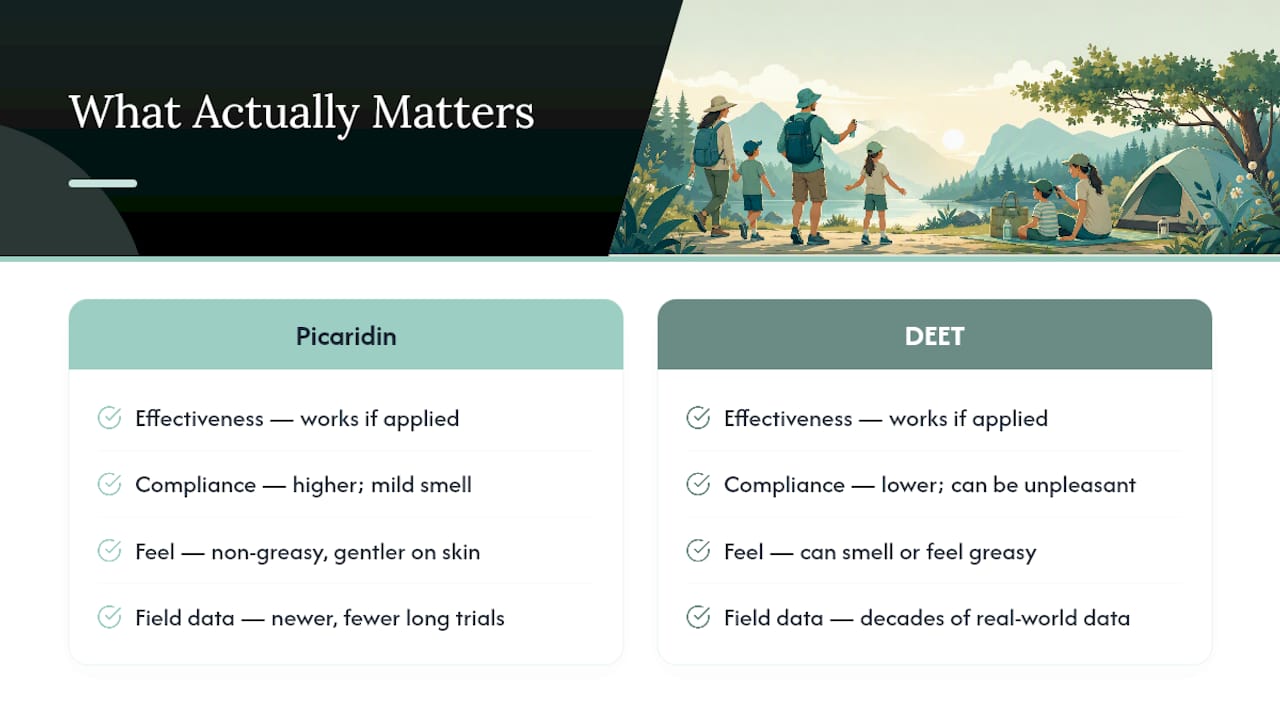
What tips the scale toward picaridin for most households isn’t a dramatic effectiveness gap, it’s compliance. People use products they don’t mind touching their skin. A repellent that doesn’t smell sharp, doesn’t feel greasy, and doesn’t wreck a pair of sunglasses is one that actually gets reapplied on schedule instead of skipped because it’s unpleasant. That’s the underrated variable nobody puts in headlines: the “better” repellent is often just the one you’ll actually use correctly, twice, on a hot day, without complaining.
DEET’s case isn’t weak, though. Its decades of field data across high-transmission regions give it a margin of confidence that newer picaridin studies haven’t fully matched yet, even if the numbers look similar in controlled trials. If someone is heading somewhere with genuine mosquito-borne disease stakes, I don’t think the marginal comfort of picaridin is worth second-guessing the more conservative, longer-proven option.
— Ayssa
Meet Totally Buggin’, a Repellent Built for Real Family Days
Totally Buggin’ is a family-friendly repellent designed for everyday use that aims not to smell harsh, feel greasy, or leave residue on sunglasses or swimsuits. It is formulated with picaridin to provide low irritation, gear compatibility, and a lighter overall footprint for skin exposed to sun and salt water.
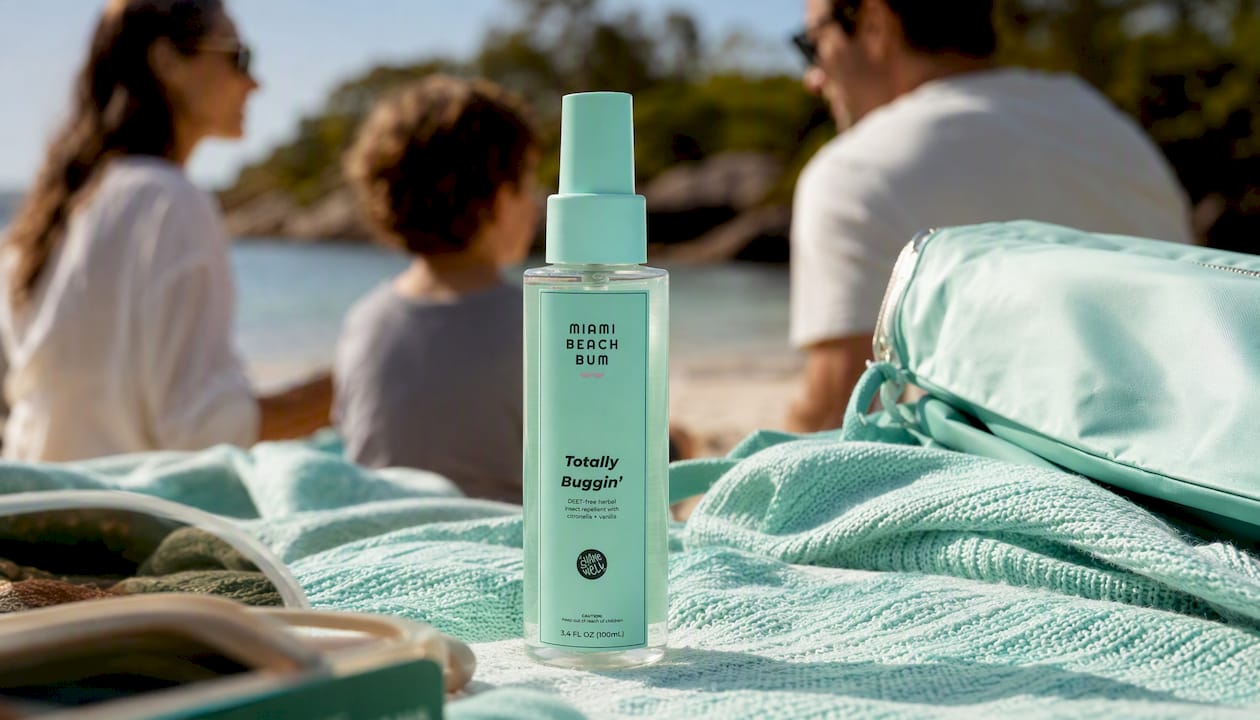
If you’re packing for a beach day, a park afternoon, or anything in between, check the Totally Buggin’ repellent page and add it to your sun care lineup before your next trip out the door.
Sources
- PubMed indexed comparative review (2018) — studies of picaridin vs DEET
- CDC — Mosquitoes, ticks, and other arthropods (Yellow Book)
- US EPA — Pesticide Fact Sheet: Picaridin (KBR 3023)
- REI Expert Advice — Insect repellent guide: DEET vs. picaridin
- National Pesticide Information Center — Picaridin fact sheet