


Blue algae extracts, particularly the phycocyanin found in blue spirulina, offer real antioxidant and anti-inflammatory support for skin, with some evidence pointing to hydration and collagen benefits too. The catch is quality control: because blue-green algae can be contaminated with microcystins during poor harvesting, you need products backed by testing, not just a pretty blue swirl on the label. If you buy from a source that can prove its algae is clean, the upside is real. If you can’t verify that, skip it.
TL;DR:
- The skin benefits of blue algae are supported by antioxidant compounds like phycocyanin, which neutralize free radicals and may help slow visible aging.
- To avoid contamination risks, consumers should verify that products have third-party testing for microcystins and heavy metals and are sourced from controlled cultivation systems.
- Most clinical evidence shows modest improvements in hydration, skin firmness, and reduction of collagen-degrading enzymes mainly from blended formulas, not isolated blue algae.
- Blue algae skincare products are most effective when used after cleansing, with serums and masks delivering the active ingredients to damp skin for better absorption.
- Sustainable and safe sourcing relies on brands providing transparent documentation of cultivation methods, third-party testing, and avoiding wild-harvested algae from uncontrolled water bodies.
Table of Contents
- Blue Algae Skincare: What Skin Benefits Are Real?
- What Peer-Reviewed Research Says, and Where It Falls Short
- Where Blue Algae Shows Up in Skincare Products
- How to Use Blue Algae Products in Your Routine
- Contamination Risks and How to Vet a Product Before You Buy
- Cultivated vs. Wild Blue Algae: Why Sourcing Should Guide Your Choice
- The Miami Beach Bum Take on Marine-Derived Actives
- Two Products That Round Out Your Beach Skincare Routine
- Sources
Blue Algae Skincare: What Skin Benefits Are Real?
Phycocyanin is the pigment that gives blue algae its signature color, and it’s also the compound doing most of the antioxidant work. Reviews of blue-green algae composition point to phycocyanin, carotenoids, gamma-linolenic acid, and polysaccharides as the bioactive components responsible for both antioxidant and anti-inflammatory effects on skin. That matters because oxidative stress from UV exposure and pollution is one of the main drivers of visible aging, and a pigment that neutralizes free radicals gives your skin a fighting chance against that daily damage.
The anti-inflammatory piece works through a different mechanism. Compounds in blue-green algae appear to dampen inflammatory signaling pathways in skin cells, which is the same general process implicated in redness, breakouts, and premature aging tied to chronic low-grade inflammation. This isn’t a cortisone-level intervention. Think of it as turning down the volume on inflammatory triggers rather than shutting them off.
Hydration is where blue algae skincare gets more interesting, largely thanks to its polysaccharide content. Marine algae carbohydrates like fucoidans and alginates function as moisturizing and thickening agents in cosmetic formulas, and topical treatments using microalgal extracts have measurably reduced transepidermal water loss (TEWL) in trials. Lower TEWL means your skin barrier is holding onto moisture better instead of losing it to the air, which is the difference between skin that looks plump and skin that looks tight and dull by afternoon.
The anti-aging claims carry more nuance. Some studies on microalgal extracts report improved skin firmness and a reduction in UVA-induced MMP-1 expression, the enzyme responsible for breaking down collagen after sun exposure. Separate research on microalgae-derived actives has found effects on collagen synthesis and wrinkle depth in certain formulations, which is why you’re seeing more of these ingredients in mainstream anti-aging lines.
Here’s what the mechanisms break down to in practice:
- Antioxidant defense: phycocyanin and carotenoids scavenge free radicals before they damage collagen and elastin.
- Anti-inflammatory support: bioactive compounds calm inflammatory signaling linked to redness and reactive skin.
- Hydration: polysaccharides bind water at the skin’s surface and may reduce transepidermal water loss.
- Collagen support: some extracts suppress MMP-1, the enzyme that breaks down collagen after UV exposure.
Pro Tip: Look for “phycocyanin” listed by name on the ingredient panel rather than just “algae extract.” Phycocyanin is unstable in high heat and UV light, so brands that bother to stabilize and list it separately usually put more care into the formula overall.
None of this makes blue algae a replacement for retinoids or broad-spectrum SPF. It’s a supporting player, one with a genuinely interesting mechanism, not a miracle pigment.
What Peer-Reviewed Research Says, and Where It Falls Short
The strongest evidence for blue algae skincare comes from reviews of marine algae carbohydrates and microalgae cosmeceutical research, not from single splashy headline studies. A widely cited review on marine algae-derived carbohydrates found that microalgal extracts improved hydration and firmness in tested models, and reduced UVA-triggered MMP-1 activity linked to collagen breakdown. A separate review on microalgae in skin repair points to clinical evidence for improved collagen synthesis and reduced wrinkle depth with certain microalgae-derived actives, which is part of why cosmetic manufacturers have been adopting these ingredients more aggressively.
“Studies report improved hydration, skin firming effects, and reduced MMP-1 upregulation with microalgal extracts, with topical treatments reducing transepidermal water loss in trials.” This is the through line across most of the credible research: measurable barrier and firmness benefits, generally modest in scale, rather than dramatic before-and-after transformations.
The limitation that matters most for skincare enthusiasts: most human and in vivo trials test blended algal extracts, not blue algae in isolation. A trial showing improved hydration often used a formula combining several marine carbohydrates, sometimes alongside other actives like resveratrol. That’s a meaningful distinction. If a product claims “clinically proven” results based on a study, ask what was actually tested. A blend result doesn’t guarantee the same outcome from a single-ingredient product, and a single-ingredient product’s performance can’t be assumed from blend data either.
Formulators have picked up on this by pairing algae extracts with delivery technologies designed to get more of the active ingredient past the skin’s surface layer. Some commercial actives combine blue algae with nanostructures or lipid-based delivery systems and complementary compounds like resveratrol to improve penetration and target cellular aging pathways, according to formulation data from Bicoalgae Blue. That’s a sign the ingredient science is maturing, even if it also means the “blue algae” on a label is frequently one piece of a more complex delivery system.
Here’s how the major evidence types stack up against each other:
| Evidence type | What it typically shows | Main limitation |
|---|---|---|
| In vitro (cell) studies | Antioxidant activity, MMP-1 suppression, inflammatory marker reduction | Doesn’t confirm real-world skin penetration or visible results |
| In vivo/animal models | Hydration improvement, firmness changes, reduced UV damage markers | Skin biology differs from human skin in thickness and repair rate |
| Small human trials | Reduced TEWL, improved hydration and elasticity scores | Often use blended formulas, small sample sizes, short duration |
| Consumer/brand-sponsored studies | Self-reported hydration, glow, softness | Rarely peer-reviewed, no placebo control, funded by the seller |
When you’re evaluating a brand’s claim, a trustworthy trial usually has a control group, a sample size large enough to matter, and a duration of at least four to eight weeks, since skin barrier changes don’t show up overnight. A study funded and run entirely in-house by the brand selling the product deserves more skepticism than one published in an independent peer-reviewed journal. Neither type of study proves an ingredient does nothing, but they carry very different evidentiary weight.
Where Blue Algae Shows Up in Skincare Products
Blue algae doesn’t just come in one form. Manufacturers work it into several product categories, and the format usually determines how concentrated and stable the active compounds are.
- Serums: the most common delivery method for blue algae, since a lightweight liquid base helps water-soluble phycocyanin penetrate without heavy occlusive ingredients blocking it.
- Sheet masks and clay masks: often use blue algae for a short, intensive antioxidant boost, though contact time is limited to 10 to 20 minutes.
- Powders: typically pure or near-pure blue spirulina, meant to be mixed into a DIY mask base like yogurt, honey, or aloe.
- Creams and moisturizers: pair algae extract with occlusive or humectant ingredients for longer-wear hydration support.
- Facial mists: usually the lowest concentration format, best for a mid-day refresh rather than a core treatment step.
Label language matters more than most shoppers realize. “Spirulina” or “Arthrospira” on an ingredient list usually means the whole-organism extract, which contains phycocyanin along with other compounds like carotenoids and polysaccharides. “Phycocyanin” listed on its own signals a more purified, targeted antioxidant compound, since blue spirulina is essentially concentrated phycocyanin pigment prized for both its color stability and its antioxidant punch. “Blue spirulina” as a marketing term almost always refers to this same phycocyanin extraction. “Algae extract” without further specification is the vaguest term on this list. It could mean blue-green algae, brown seaweed, red algae, or a blend, so it tells you almost nothing about what the product actually contains or at what concentration.
Formulators frequently pair blue algae with hyaluronic acid, since the polysaccharide-rich algae complements hyaluronic acid’s own water-binding properties for a layered hydration effect. Resveratrol is another common partner, often included to work alongside algae’s antioxidant activity and to support penetration in more advanced delivery systems. If you see either of these listed near algae extract on an ingredient panel, that’s usually a deliberate formulation choice, not filler.
How to Use Blue Algae Products in Your Routine
Blue algae fits into skincare as a treatment step, not a cleanser or a final barrier layer, so where you place it matters.
- Cleanse first. Remove makeup, sunscreen, and the day’s grime with a gentle cleanser so the algae serum or mask can actually reach your skin instead of sitting on residue.
- Apply the algae treatment. If it’s a serum, use it on slightly damp skin to help polysaccharides bind moisture. If it’s a mask, follow the product’s stated contact time, since leaving clay-based masks on too long can dry out skin rather than hydrate it.
- Layer a moisturizer. Seal in the treatment with a cream or lotion, ideally one with occlusive ingredients that lock in what the algae just delivered.
- Finish with SPF in the morning. Antioxidants support your skin’s defenses, but they don’t replace sun protection. A reef-safe mineral sunscreen serum covers the UV protection that algae extracts alone can’t provide.
Powdered blue spirulina needs a different approach than a pre-formulated serum. Mix it fresh each time with a base like plain yogurt or aloe vera gel, since the powder can oxidize once wet and lose potency if left to sit. Start with a small amount, roughly a quarter teaspoon for a full-face mask, and adjust based on how vivid you want the color and intensity.
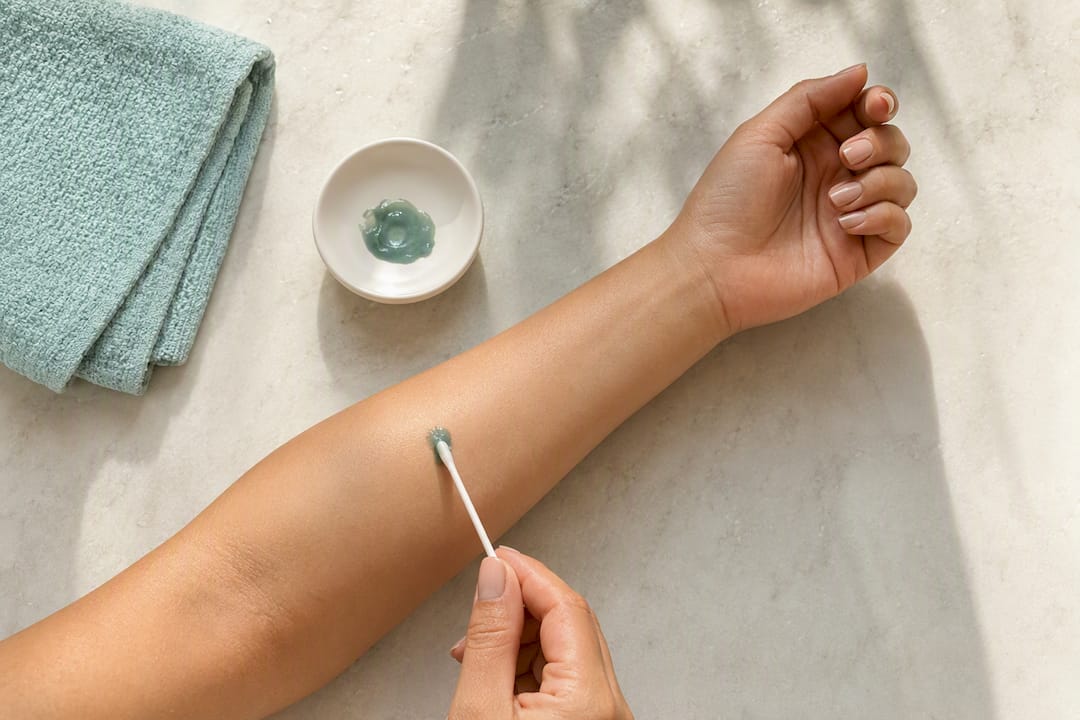
If you’re combining blue algae with retinoids or chemical exfoliants like glycolic or salicylic acid, introduce them on alternating nights rather than stacking everything at once. Retinoids and strong acids increase skin sensitivity, and while blue algae itself is generally well tolerated, layering multiple active ingredients raises your odds of irritation regardless of how gentle any single one is. Always patch-test a new algae product on your inner forearm for 24 to 48 hours before applying it to your face, especially if you have a history of allergies to marine ingredients or shellfish.
Pro Tip: If your homemade algae mask stains your skin or towel with a stubborn blue-green tint, that’s the phycocyanin pigment, not a sign of poor quality. Rinse with lukewarm rather than hot water, since heat degrades the pigment and makes it harder to remove evenly.
Contamination Risks and How to Vet a Product Before You Buy
The biggest safety concern with blue algae skincare isn’t an allergic reaction. It’s contamination. Wild-harvested blue-green algae grown in uncontrolled ponds or waterways can accumulate microcystins, a class of cyanotoxins that can cause liver damage, along with heavy metals absorbed from polluted water. The FDA has issued specific warnings about microcystin contamination in blue-green algae products and recommends that consumers look for testing evidence before use.
This risk is genuinely higher for algae sourced from open, uncontrolled bodies of water than for algae grown in monitored aquaculture systems. Products from controlled cultivation with documented certificates of analysis carry a lower documented contamination risk than algae scooped from natural lakes or waterways, which is exactly why sourcing transparency should factor into your buying decision as much as the ingredient list itself.
Before adding a blue algae product to your cart, run through this checklist:
- Certificate of Analysis (COA): a legitimate brand should be able to provide or reference third-party lab testing confirming the batch is free of microcystins and heavy metals.
- Country and method of cultivation: look for language specifying controlled aquaculture rather than vague “wild-harvested” or “sustainably foraged” claims with no location given.
- Good Manufacturing Practice (GMP) certification: this signals the facility follows standardized quality and safety protocols, not just marketing hygiene.
- Species clarity: the label should specify the exact species, such as Arthrospira platensis, rather than the generic catchall “blue-green algae.”
- Red flags: avoid products with no batch information, no sourcing details, and pricing that seems too low for a marine ingredient requiring careful processing.
Vulnerable groups need extra caution here. Pregnant individuals, people with autoimmune conditions, and anyone with existing liver disease should talk to a healthcare provider before using algae-based supplements or heavily concentrated topical extracts, since consumer health guidance flags potential interactions and side effects including nausea, rash, and digestive upset even from ingested forms. Topical use carries a different, generally lower risk profile than swallowing algae supplements, but if you develop unusual redness, swelling, or a rash after applying an algae product, stop immediately and consult a dermatologist rather than assuming it will resolve on its own.
Cultivated vs. Wild Blue Algae: Why Sourcing Should Guide Your Choice
Where your blue algae comes from affects both its safety and its environmental footprint, and the two are more connected than most shoppers assume. Cultivated microalgae grown in closed, monitored systems generally carry lower contamination risk and better traceability than algae harvested from open waterways, since growers can control water quality, nutrient input, and testing at every stage. That control also tends to reduce the environmental impact compared with large-scale wild harvesting, which can disrupt aquatic ecosystems and depend on unpredictable natural bloom cycles.
Wild-harvested claims sound appealingly natural on packaging, but “wild” doesn’t automatically mean cleaner or more sustainable. It often means less oversight, less consistency between batches, and a higher chance the algae absorbed whatever was in the water it grew in, including agricultural runoff or industrial pollutants. Cultivated sources, by contrast, let a brand control inputs closely enough to make safety and sustainability claims that actually hold up under scrutiny.
Questions worth asking any brand selling blue algae skincare:
- Is the algae grown in a closed cultivation system, or harvested from open water?
- Can you provide sourcing documentation or third-party sustainability certification?
- What is the traceability process from harvest to finished product?
- Are the packaging and shipping practices consistent with reef-safe or ocean-conscious claims, not just the ingredient itself?
That last question matters more than it might seem. An ingredient can be sustainably sourced while the rest of the formula, from preservatives to packaging, works against ocean health. Understanding what ocean-safe skincare actually requires helps you evaluate the whole product, not just the headline ingredient.
The Miami Beach Bum Take on Marine-Derived Actives
Marine ingredients earn a lot of hype, and not all of it holds up once you look at the sourcing behind it. What draws me to blue algae specifically is that the mechanism is legitimate. Phycocyanin’s antioxidant activity and the polysaccharide hydration story aren’t marketing inventions, they’re grounded in real cell and clinical research. But I’d rather see a reader skip a trendy algae serum entirely than buy one from a brand that can’t answer a basic question about where its algae came from.
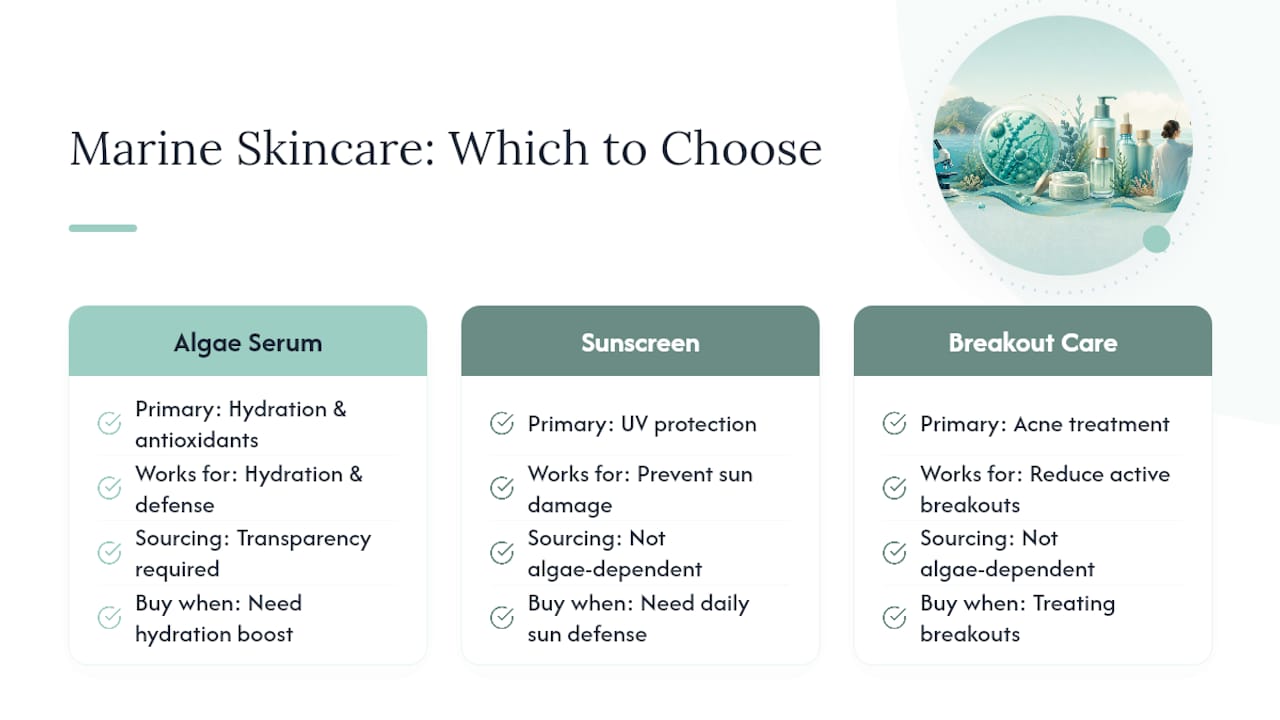
That’s the same standard we hold ourselves to with marine collagen and seaweed-derived ingredients: sourcing transparency isn’t a nice extra, it’s the difference between a genuinely beneficial ingredient and a liability wearing a trendy color. If you’re weighing an algae-focused serum against a reef-safe sunscreen or a body-care product for active breakouts, think about what problem you’re actually solving. Algae topicals target hydration and antioxidant support. Sun protection and breakout relief need dedicated formulas built for those specific jobs.
— Ayssa
Two Products That Round Out Your Beach Skincare Routine
Blue algae treats your skin barrier, but sun and salt water bring their own set of problems that no serum solves alone. There are leave-in conditioners designed to protect hair from sun, chlorine, and salt damage during and after beach days, which is the same environmental stress that dries out skin too.
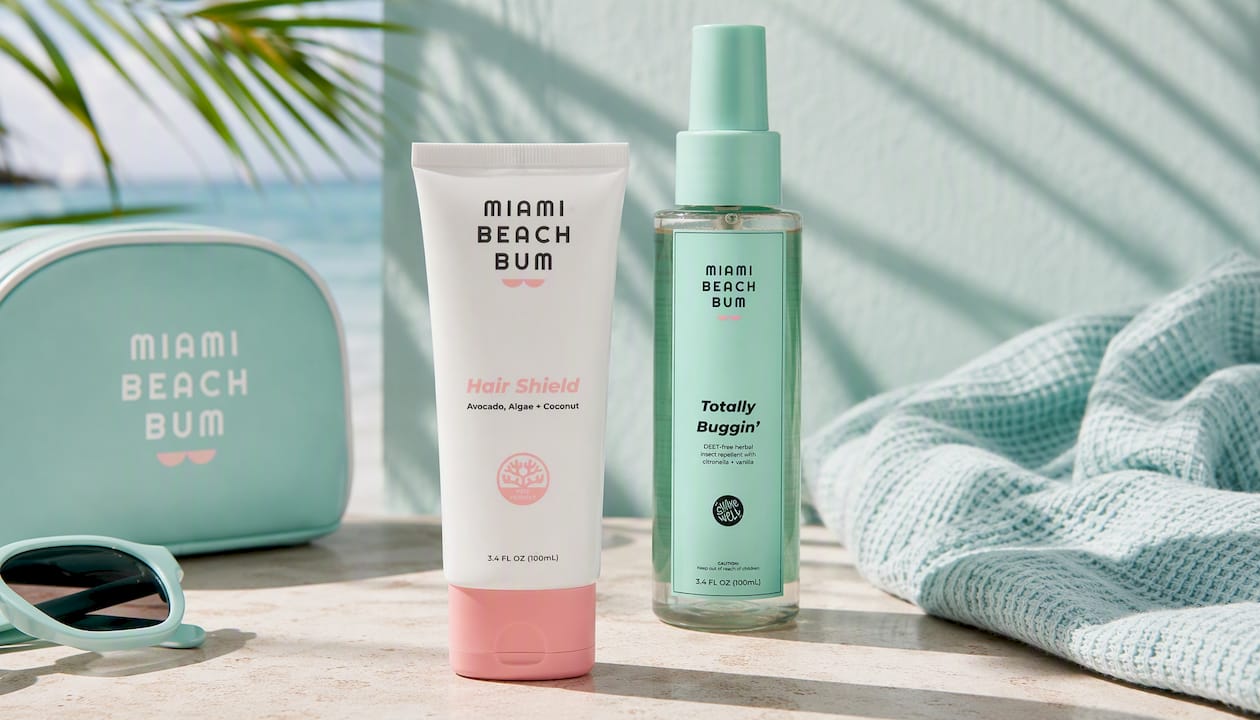
Some botanical repellents handle outdoor skin care for bug bites, and are made without the harsh synthetic chemicals found in many drugstore sprays, which may matter for those selective about what touches their skin. Pair it with your antioxidant serum and a mineral sunscreen and you’ve covered UV exposure, hydration, and pest protection in one routine, without layering on ingredients that fight against the reef-safe, marine-conscious approach you’re already building. Ready to fill in the gaps your algae serum can’t cover? Check out Hair Shield and Totally Buggin’ and add whichever one matches your next beach trip.
Sources
The clinical and safety claims in this guide draw from peer-reviewed research and regulatory sources, not marketing copy. The PMC review on marine algae-derived carbohydrates and the review on blue-green algae health benefits provide the mechanistic and clinical backbone for the skin benefit claims. The FDA’s guidance on microcystins and WebMD’s consumer safety overview anchor the safety and contamination sections, since both come from sources built specifically to flag real-world risk rather than sell a product.
This article is general information, not a substitute for advice from a qualified doctor. Consult a qualified healthcare professional about your own circumstances before acting on anything here.
- Health Benefits of Blue-Green Algae: Prevention of Cardiovascular Disease and Nonalcoholic Fatty Liver Disease - PMC
- Blue-green algae products and microcystins | FDA
- Blue-Green Algae: Overview, Uses, Side Effects, Precautions, Interactions, Dosing and Reviews - WebMD