


Yes, marine-derived ingredients can measurably improve your skin, but only certain classes back that claim with real evidence. Algae and seaweed extracts, marine collagen, polysaccharides like fucoidan and carrageenan, mycosporine-like amino acids (MAAs), and sea minerals show documented gains in hydration, antioxidant protection, and barrier strength. The catch is sourcing: efficacy means little if the harvest strips a reef or a kelp bed bare.
TL;DR:
- Only a small subset of marine ingredients, such as MAAs, fucoidan, and marine collagen, have demonstrated measurable skin hydration and anti-aging benefits.
- Sourcing sustainability matters, with farmed or upcycled seaweed being preferable to wild harvests, which can harm coastal ecosystems.
- Clinical evidence for marine actives is limited mostly to small trials or lab studies; large-scale, long-term research remains scarce.
- Proper label reading requires specific INCI names and transparency about harvest location, species, and production methods, rather than vague marketing claims.
- Marine ingredients generally complement other actives like retinoids and vitamin C but require correct layering and patch-testing to avoid sensitivity issues.
Table of Contents
- What Are the Main Types of Marine Skincare Ingredients?
- How Effective Are Marine Ingredients for Hydration and Aging?
- Is Wild-Harvested or Farmed Seaweed Better for Your Skin and the Ocean?
- What Should You Check on a Marine Skincare Label?
- How Do You Add Marine Ingredients to a Skincare Routine?
- How Miamibeachbum Approaches Marine Ingredients Responsibly
- Are Marine Skincare Ingredients Regulated the Same Way as Synthetic Ones?
- Can You Mix Marine Ingredients With Retinoids and Vitamin C?
- Balancing Efficacy With Ocean Stewardship
- Where to Find Reef-Safe Marine Ingredients in a Real Routine
- Sources
- FAQ
What Are the Main Types of Marine Skincare Ingredients?
“Marine ingredients skincare” is a shorthand for a wide biological toolkit, and the industry term you’ll see on ingredient decks is marine bioactives. Reviews of marine natural products point to algae, both macro and micro, as the richest source of usable compounds, packed with polysaccharides, polyphenols, and carotenoids that do real work on skin.
Here’s how the major classes break down by source and function:
- Macroalgae (kelp, brown, red, and green seaweeds): Harvested from coastal waters, these deliver alginate, fucoidan, and phlorotannins. Kelp extract shows up most often in hydrating gels and body creams.
- Microalgae (spirulina, chlorella, and diatom extracts): Grown in controlled tanks or ponds, these skew toward antioxidant and mineral-rich formulas since they’re easier to farm consistently than wild seaweed.
- Marine collagen and peptides: Extracted from fish skin and scales, then broken down into hydrolyzed peptides small enough to penetrate and support the skin’s own collagen network.
- Marine polysaccharides: Fucoidan (from brown algae), alginate (a gelling agent from kelp), and carrageenan (from red algae) each act as a humectant or texturizer, trapping water at the skin’s surface.
- Mycosporine-like amino acids (MAAs): Natural sunscreens that algae and seaweed produce to survive UV exposure, now isolated for antioxidant and hydration use in serums.
- Marine minerals and seawater: Sodium, magnesium, and trace minerals from seawater or Dead Sea sources, often used in toners and soaking treatments for their soothing effect.
Each class earns its place on an ingredient list for a different reason, which is why label reading matters more than chasing a single buzzword.
How Effective Are Marine Ingredients for Hydration and Aging?
The strongest single data point in marine skincare comes from a 2025 clinical study on an MAA nanoemulsion derived from nori seaweed. Researchers measured a a substantial improvement in skin hydration, with sustained reductions in transepidermal water loss (TEWL), in a randomized, double-blind trial of 20 volunteers. The full nori-derived MAA study is small in sample size, but it’s one of the more direct hydration measurements available for this ingredient class.
Key finding: A nanoemulsion built around MAAs from nori seaweed produced a substantial hydration boost at 4 hours, with TEWL reductions holding up over the test window, in a controlled study of 20 participants.
Beyond that single trial, evidence for marine actives clusters into a few reliable patterns:
- Hydration and barrier support: Fucoidan, alginate, and carrageenan all act as water-binding agents, and review literature on marine natural products consistently flags polysaccharides as moisturizing, antioxidant, and anti-inflammatory.
- Marine collagen for firmness: Short-term trials on hydrolyzed fish collagen peptides show increases in skin moisture and dermal collagen density after weeks of use, whether applied topically or taken orally.
- Antioxidant and anti-aging activity: Carotenoids like astaxanthin, extracted from marine sources, show antioxidant action and effects on fibroblast activity tied to visible anti-aging benefits, according to a review on marine by-product bioactives.
- Anti-elastase and anti-inflammatory effects: Several marine polyphenols and phlorotannins show activity against elastase, the enzyme that breaks down elastin, though most of that evidence still comes from in vitro work rather than large human trials.
The honest caveat: most of these findings come from small clinical trials or in vitro assays, not large-scale, multi-year studies. Treat individual numbers as promising signals, not universal guarantees, and weigh systematic reviews more heavily than single-brand claims.
Is Wild-Harvested or Farmed Seaweed Better for Your Skin and the Ocean?
Sourcing determines whether a marine ingredient helps your skin without hurting the ecosystem it came from. Wild-harvested kelp can strip coastal beds faster than they regenerate if collection isn’t managed, while farmed or regeneratively grown seaweed offers a lower-impact path to the same active compounds. Kelp forests do real ecological work, buffering coastlines and supporting marine biodiversity, so how a brand sources its algae isn’t a side detail. It’s central to whether the product deserves the word “sustainable.”
Upcycling marine by-products, fish skins, scales, crustacean shells, has become one of the more promising shifts in the category. A comprehensive review of marine by-product valorization documents collagen peptides, chitin, and carotenoids pulled from seafood processing waste that would otherwise be discarded, delivering measurable moisturizing and anti-aging activity while easing pressure on wild stocks.
What to look for when a brand claims sustainable sourcing:
- Named harvest location or farm, not a vague “ocean-sourced” label
- Certifications or third-party sourcing audits, referenced by name
- Explicit mention of upcycled or by-product origin versus wild harvest
- Packaging and supply-chain transparency claims that go beyond marketing copy
Pro Tip: If a product’s marine ingredient claim doesn’t name a species, harvest method, or region, treat it as a marketing flourish rather than a sourcing fact.
Industry groups tracking the Blue Beauty movement argue that traceability and regenerative farming are becoming baseline expectations, not premium add-ons, as more brands scale algae-derived ingredients.
What Should You Check on a Marine Skincare Label?
Reading a marine ingredient label takes a slightly different eye than scanning for retinol or niacinamide. Look for specific INCI names like “Hydrolyzed Fish Collagen” or “Fucus Vesiculosus Extract” rather than generic terms, since specificity usually signals a formulator who sourced deliberately rather than one leaning on ocean imagery for marketing.
A few checks worth running before you buy:
- Allergen flags: Anyone with a shellfish allergy should be cautious with chitin or chitosan derivatives, which come from crustacean shells and can trigger reactions in sensitive people.
- Preservative system: Marine extracts are often water-based and prone to microbial growth, so check that a proper preservative is listed, not just “natural preservation.”
- Stability claims: Nanoemulsion technology, like the one used in the nori MAA study, requires tight formulation control. It’s fair to ask a brand how they stabilize these actives.
- Vague marketing phrases: “Marine-powered” or “ocean-derived” on their own tell you nothing about concentration or species. Cross-check against the actual ingredient list.
How Do You Add Marine Ingredients to a Skincare Routine?
Match the format to your goal rather than grabbing whatever says “seaweed” on the front.
- For daily hydration, reach for a lightweight serum or gel with fucoidan, alginate, or MAAs. Apply after cleansing, before heavier creams.
- For barrier repair or dryness, look for marine collagen peptides in a cream format, layered as the last step before SPF in your morning routine.
- For exfoliation and circulation, a marine mineral or algae-based body scrub works well once or twice a week, not daily.
- For sensitive skin, patch-test any new marine active on your inner arm for 48 hours before applying it to your face.
Marine actives strengthen and hydrate skin, but none of them block UV rays the way a mineral sunscreen does. Pair them with daily SPF rather than treating antioxidant serums as sun protection.
Pro Tip: Apply antioxidant-rich marine serums in the morning under sunscreen. Their real value is helping neutralize UV-driven free radical damage throughout the day, not replacing SPF.
How Miamibeachbum Approaches Marine Ingredients Responsibly
Miamibeachbum’s products are formulated by a marine scientist with a reef-safe standard built into every ingredient decision. That’s not a marketing tagline. It shapes how the brand sources and tests its ocean-safe skincare formulas. Readers who want a deeper dive can check out the brand’s breakdowns of marine collagen for skin and blue algae skincare safety, both written to help shoppers evaluate marine claims critically rather than take them at face value.
Are Marine Skincare Ingredients Regulated the Same Way as Synthetic Ones?
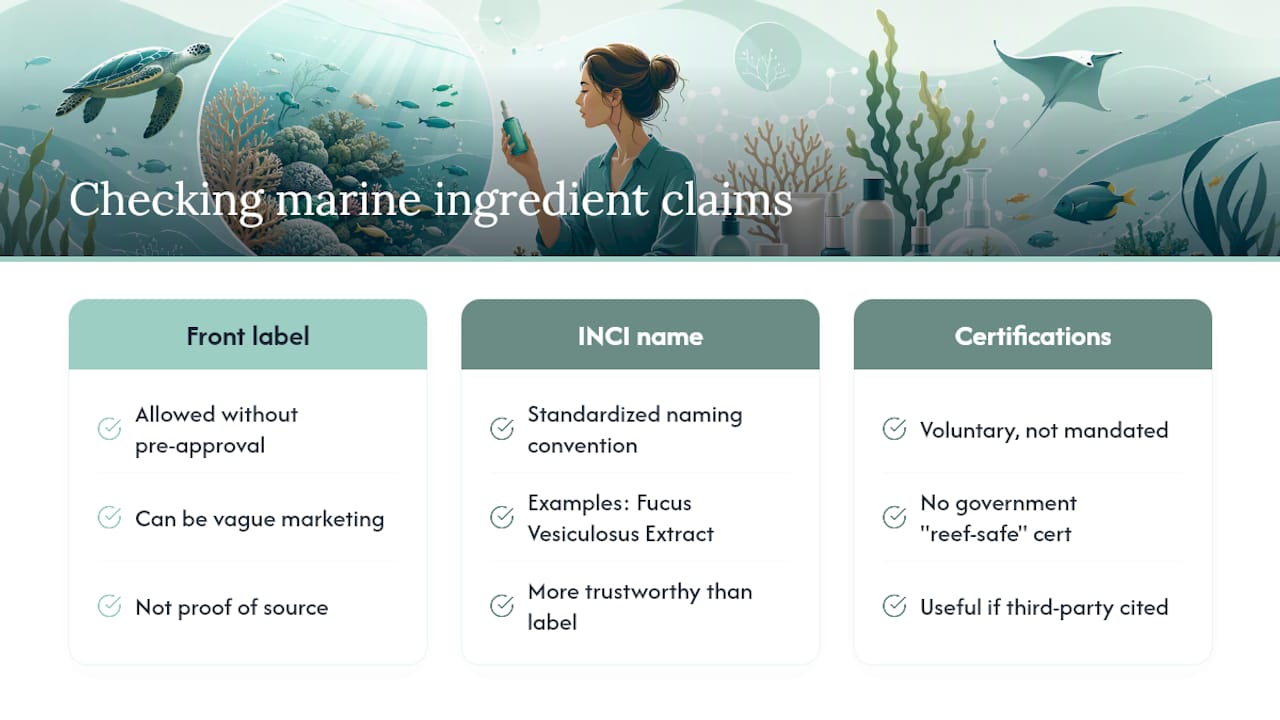
Marine-derived ingredients face the same regulatory framework as any other cosmetic ingredient in the United States: the FDA requires accurate labeling and prohibits misbranded or adulterated products, but it does not pre-approve cosmetic formulas before they reach shelves. This means a brand can legally use terms like “marine-derived” or “ocean-sourced” without third-party verification of where the ingredient actually came from.
INCI (International Nomenclature of Cosmetic Ingredients) names are the one place where standardization exists. A listing like “Fucus Vesiculosus Extract” or “Hydrolyzed Fish Collagen” follows a fixed naming convention, which makes those specific terms more trustworthy than a front-label claim like “sea-powered formula.” If an ingredient list only shows vague marketing language with no INCI backup, that’s a signal to look elsewhere on the packaging or the brand’s site for sourcing detail.
Sustainability certifications add another layer, though they remain voluntary rather than mandated. No single government body currently certifies “reef-safe” status for skincare in the way it certifies, say, organic food. Brands that make reef-safe or Blue Beauty claims are self-attesting unless they cite a specific third-party standard. That gap is exactly why supply-chain transparency, naming a harvest location, a farming method, or an upcycling process, matters more for marine ingredients than for most other cosmetic categories. Readers evaluating a marine skincare product should treat regulatory labeling as a floor, not a guarantee, and weigh a brand’s specificity about sourcing as the more reliable signal.
Can You Mix Marine Ingredients With Retinoids and Vitamin C?
Marine ingredients generally play well with other active ingredients, which is one reason they show up so often in hybrid formulas rather than as standalone treatments. Polysaccharides like fucoidan and alginate are humectants, meaning they hold water rather than exfoliate or alter cell turnover, so they don’t compete chemically with retinoids or vitamin C the way two exfoliating acids might.
That said, layering order still matters. Vitamin C performs best in a low pH environment, and pairing it directly with a mineral-heavy marine toner can shift that pH and reduce potency. The safer approach is applying vitamin C serum first, letting it absorb for a few minutes, then following with a marine collagen or algae-based moisturizer to lock in hydration without disrupting the vitamin C’s chemistry.
Retinoids pair especially well with marine hydrators because retinoid use commonly causes dryness and barrier disruption during the adjustment period. A marine polysaccharide cream applied after a retinoid, or on alternating nights, can offset some of that irritation without diluting the retinoid’s effect, since the two ingredient types work through entirely different mechanisms. Marine minerals in soaking treatments or toners are the one category worth introducing cautiously alongside retinoids, since both can increase sensitivity in people with reactive skin. Patch-test any new combination for a week before committing to nightly use, especially if you’re already using a prescription-strength retinoid.
Balancing Efficacy With Ocean Stewardship
The science on marine ingredients is real, but so is the responsibility to source it well. Choose traceable products, patch-test new marine actives, and treat the ocean as a partner, not just a supply chain.
— Ayssa
Where to Find Reef-Safe Marine Ingredients in a Real Routine
Miamibeachbum’s approach centers on formulas that work as hard on your skin as they do on protecting the water you swim in, without the toxic UV filters and synthetic fillers common in mass-market body care. The bodycare collection leans on marine and botanical actives across creams and scrubs built for breakout-prone, sun-exposed skin.
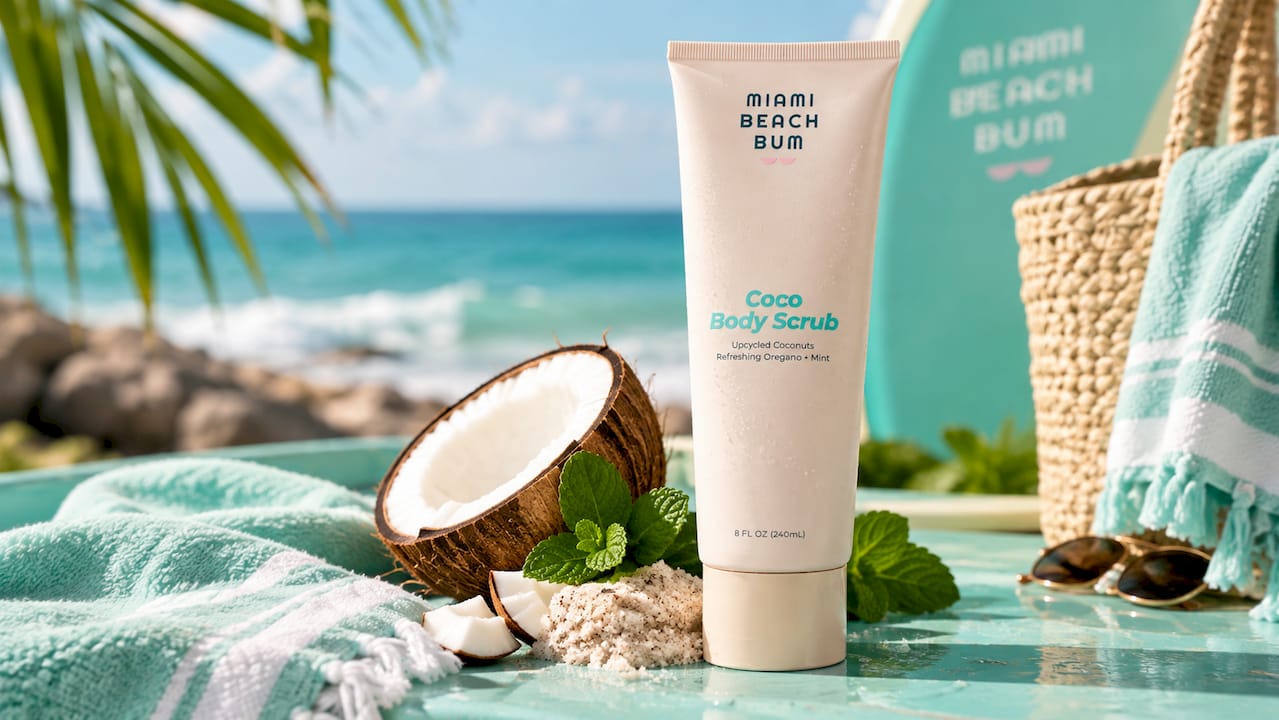
The Coco Body Scrub is a practical entry point if you want to feel the difference marine minerals and botanical exfoliants make without guessing at concentrations or sourcing claims. Pair it with something from the outdoor collection for sun protection that won’t undo the reef-conscious sourcing you just read about. Browse the bodycare lineup and pick one product to test this week.
Sources
Claims in this article draw on peer-reviewed reviews of marine natural products and marine by-product valorization, plus the 2025 MAA nanoemulsion clinical study and industry sustainability resources from NATRUE on Blue Beauty and beauty industry analysis from 121 Group.
- Marine Natural Products as Innovative Cosmetic Ingredients
- A Comprehensive Review on the Valorization of Bioactives from Marine Animal By-Products for Health-Promoting, Biofunctional Cosmetics
- The benefits of marine skincare - Biodiversity (NATRUE / Blue Beauty perspectives)
FAQ
What Is Marine Skincare?
Marine skincare refers to products formulated with ingredients derived from ocean sources, including algae, seaweed, marine collagen, sea minerals, and polysaccharides like fucoidan and carrageenan, chosen for hydration, antioxidant, and barrier-supporting benefits.
Are Marine Ingredients Safe for Sensitive Skin?
Most marine polysaccharides and MAAs are well tolerated, but anyone with a shellfish allergy should check for chitin or chitosan derivatives, and everyone should patch-test new marine actives for 48 hours before full use.
Do Marine Ingredients Replace Sunscreen?
No. Marine antioxidants and MAAs support skin’s resilience against UV-related stress, but they don’t block UV rays the way a mineral sunscreen does, so daily SPF still belongs in your routine.
What Are Examples of Marine-Based Skincare Products?
Common examples include seaweed-based hydrating serums, marine collagen creams, fucoidan-infused gels, mineral body scrubs like Miamibeachbum’s Coco Body Scrub, and MAA-based antioxidant treatments.
How Do You Know if a Marine Skincare Claim Is Legitimate?
Check the ingredient list for specific INCI names, a named harvest source or upcycling process, and any third-party sourcing detail, since vague phrases like “ocean-powered” without backup usually signal marketing rather than a formulated active.