


You can fully cover your back alone using a spray sunscreen checked in a mirror, a long-handled applicator, or the towel spread method. Pick whichever matches what’s in your bag right now, use an SPF 30 or higher broad-spectrum formula, wait a suitable amount of time for the sunscreen to absorb before you head into the sun, then confirm coverage with a mirror before you commit to a full day outside.
TL;DR:
- Using a long-handled applicator or foam roller offers the most control and minimal product waste for solo back sunscreen application.
- Spray sunscreen is the fastest method for full coverage, but it requires rubbing in afterward and may lose product if applied in wind.
- Reapply sunscreen every 15 to 30 minutes, especially after swimming, sweating, or towel-drying, to maintain effective protection.
- Common missed spots include the center of the spine, shoulder blades, lower back near the belt line, and under straps, which require visual checks via mirror or photos.
- Miami Beach Bum’s Blocked SPF50 provides a reef-safe, high-SPF option ideal for quick reapplication without tools, making solo back coverage simpler.
Table of Contents
- How Do You Apply Sunscreen to Your Back Alone?
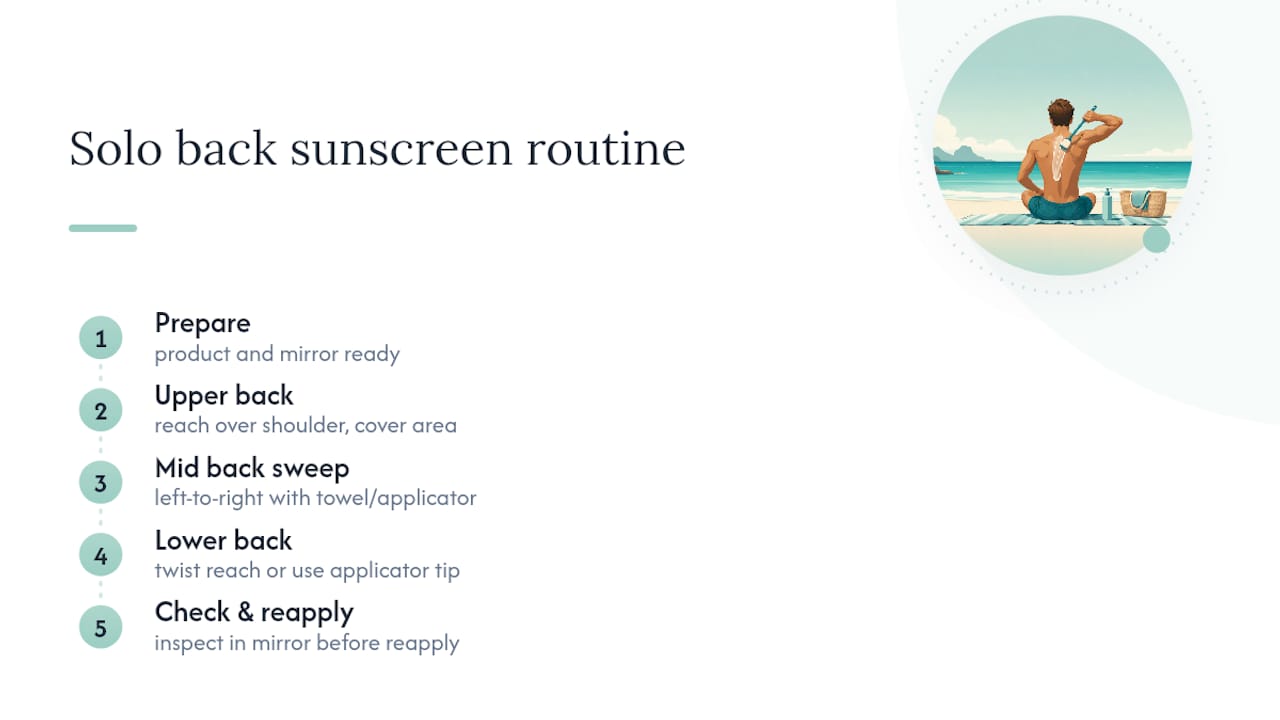
- A Step-by-Step Routine for Covering Your Whole Back
- Which Applicators and Tools Actually Work?
- When Should You Reapply Sunscreen on Your Back?
- Where Do People Miss Sunscreen on Their Back?
- Miami Beach Bum’s Solo Application Checklist
- Why Solo Back Coverage Gets Overcomplicated
- Make Solo Back Coverage a Non-Issue With Blocked SPF50
- Sources
- FAQ
How Do You Apply Sunscreen to Your Back Alone?
Every solo method trades off speed, precision, and product waste. Here’s how the main options stack up against each other.
- Spray sunscreen: The fastest option for full back coverage and easiest to aim over your own shoulder. The tradeoff is inhalation risk in wind and uneven spots if you don’t rub it in afterward. So, check the label to see if rubbing is required.
- Long-handled applicator or foam roller: Precise, low waste, and reusable, which makes it the best pick if you’re heading to the beach regularly rather than once a season.
- Towel or plastic-wrap spreading: Simple and requires no purchase, but it soaks up a chunk of your product into the fabric and often needs two or three passes to get even coverage.
- Reach-and-twist by hand: Zero tools required, but your natural range of motion leaves the center of your back and lower edges chronically underprotected for most body types.
If you have limited shoulder mobility, a healing injury, or need precise coverage for a medical reason, asking someone nearby for 30 seconds of help beats any workaround. The American Cancer Society specifically recommends getting help or using a spray or applicator for hard-to-reach areas rather than skipping them.
A Step-by-Step Routine for Covering Your Whole Back
Set up before you start: pick your product, remove any top layer that will get in the way, prop a phone or hand mirror where you can see your back, and keep a towel within reach for spills.
- Upper back. Reach one arm over the same-side shoulder and sweep downward from your neckline to the middle of your shoulder blades. Switch arms and repeat from the other side to cover the gap in the middle.
- Mid back. This is where a towel-spread or applicator does the most work. Load the applicator, sweep left to right in overlapping bands, and glance at your mirror between passes to catch thin spots.
- Lower back. Reach under and behind with a twisting motion, or use the tip of a long-handled applicator to trace the beltline and hips, where waistbands and swimsuit edges tend to rub sunscreen off fast anyway.
- Coverage check. Turn around in front of a mirror or snap a selfie with your phone’s back camera. White streaks or shiny gaps mean you missed a spot. Go back and press more product into those areas rather than layering a fresh coat over the whole back.
Don’t skimp on quantity to save time. Most people apply far less than the label amount assumes, and a thin, quick pass is the single biggest reason people burn on the back specifically.
Pro Tip: Do your back first, before your arms and legs. You’ll have full range of motion and patience left, and you won’t rush the one area you genuinely cannot see.
The Howcast demonstration on solo back application walks through this same reach, towel, and applicator sequence on camera if you want to watch the motion before trying it yourself.
Which Applicators and Tools Actually Work?
A commercial long-handled lotion applicator, usually a foam or silicone pad on an extendable pole, gives you the most control and the least waste of any solo tool. Non-absorbent fabric applicator strips work similarly and fold flat for a beach bag. Both cost a little upfront but pay for themselves if you’re reapplying multiple times a day all summer.
If you’d rather not buy anything, repurposed household items work in a pinch:
- A foam paint roller (unused, cleaned) spreads lotion in wide, even bands across the mid back.
- A backscrubber sponge on a handle already built for shower use doubles well as a sunscreen applicator.
- A spatula wrapped in a clean towel gives you reach without direct hand contact, though it’s the messiest of the three.
Continuous-spray sunscreen remains the fastest tool overall for hard-to-reach areas like the back. Spray in short bursts rather than one long pass, and rub it in afterward if the label calls for it, since sprays applied straight into wind lose a surprising amount of product before it ever lands on skin. Towels conserve almost nothing (a lot of product stays in the fabric), while non-absorbent applicators waste very little, which matters if you’re going through a bottle a week at the beach.
When Should You Reapply Sunscreen on Your Back?
Lotion needs 15 to 30 minutes to absorb and form a protective film before you step into direct sun, per CDC guidance. Sprays generally follow the same window even though they feel dry faster.
- Reapply regularly, especially after swimming, heavy sweating, or toweling off, regardless of the label’s water-resistance claim.
- Keep a spray bottle in your bag for fast touch-ups; save the applicator for your first full lotion application of the day.
- If you’re also using bug spray, sunscreen goes on first, with a short wait between products.
Where Do People Miss Sunscreen on Their Back?
The center of the spine, the strip between the shoulder blades, the lower back near the belt line, and the skin under bra or swimsuit straps are the four spots that get missed most often, since none of them are visible without a mirror and none are easy to reach with a straight arm.
- Do a mirror pass first, before you assume you’re covered.
- A quick towel pass over the shoulder blades catches what a hand sweep misses.
- For mineral sunscreen white cast, rub gently and add a thin second pass rather than piling on more product at once.
- If you keep missing the same spot with a towel, switch to an applicator instead. Repeating the same failed method wastes time.
Pro Tip: Take the mirror photo before you leave the house, not after you’ve already been in the sun for twenty minutes. A missed spot is a five-second fix at home and a painful mistake at the beach.
Miami Beach Bum’s Solo Application Checklist
Miami Beach Bum’s own field-tested heuristic for spray sunscreen is roughly six seconds per limb, close enough range and a steady sweep to actually saturate skin rather than mist over it. That same pacing works on the back in three or four passes rather than one quick blast.
The full routine, condensed: prep your product and mirror, cover the upper back with the over-the-shoulder reach, sweep the mid back left to right with a towel or applicator, finish the lower back with a twist reach or applicator tip, then check everything in a mirror before you reapply. For layering sunscreen under a body lotion or moisturizer, the sequence matters, and Miami Beach Bum’s guide to layering sunscreen and body lotion covers which product goes on first.
Why Solo Back Coverage Gets Overcomplicated
Most sunscreen advice treats the back like a special problem requiring special gear, and that framing gets the emphasis backward. The real failure point isn’t lack of tools, it’s rushing the check. Plenty of people own a perfectly good applicator or spray can and still burn between the shoulder blades because they never actually looked.
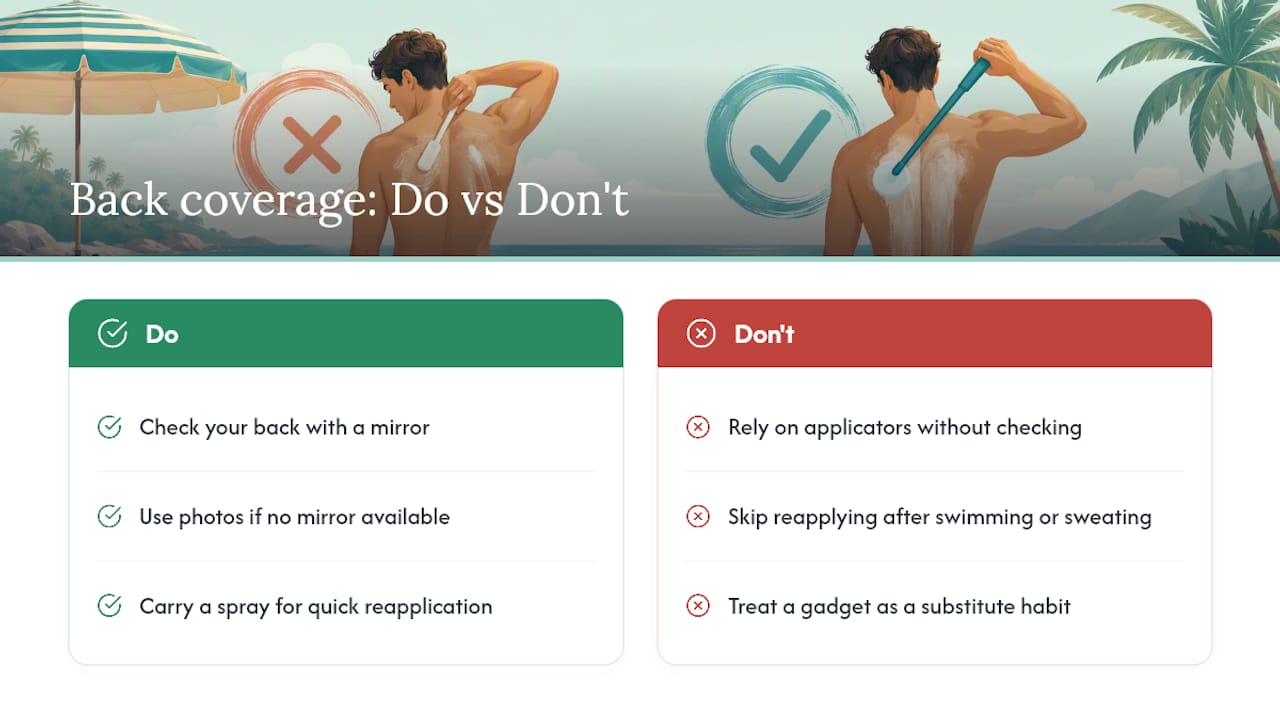
The mirror check is the step everyone skips, and it’s the one that matters most. A spray can or applicator gets product onto your skin; only a mirror or a photo tells you whether it landed evenly. If you take one thing from this routine, make it that habit rather than a new gadget.
Conventional advice also tends to undersell reapplication as an afterthought when it’s arguably the harder problem. Applying sunscreen once at home is easy. Doing it again after you’ve been swimming, sweating, and toweling off for two hours, standing on hot sand with wet hands, is where most people quietly give up and just skip the back entirely. That’s exactly the moment a spray can in your bag earns its space, because nobody is rebuilding the full towel and applicator routine mid beach day.
— Ayssa
Make Solo Back Coverage a Non-Issue With Blocked SPF50
Miami Beach Bum built Blocked SPF50 as a reef-safe, mineral, high-SPF formula specifically for the moments when a towel and an applicator aren’t practical, meaning a quick reapply between swims or a solo trip where nobody’s around to help with your back.
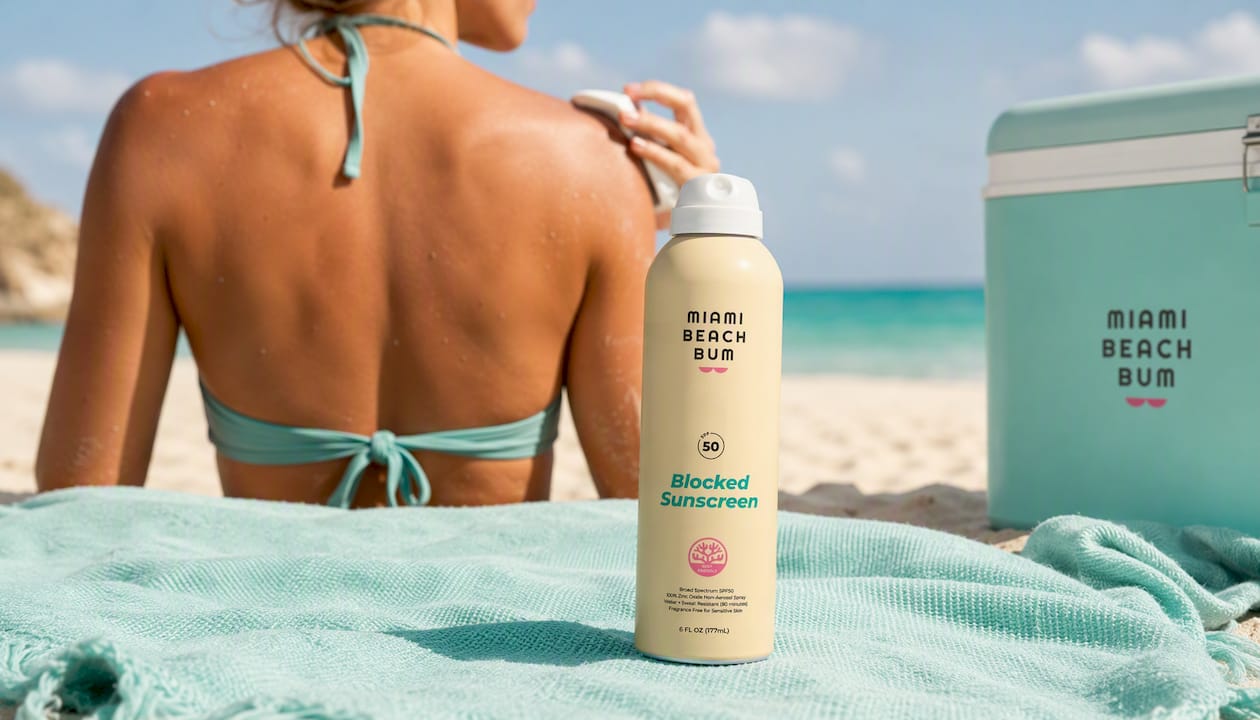
Used as a spray, it fits the six-second-per-limb pacing covered above: short, steady passes across the mid and lower back, then a rub-in if you want extra insurance against missed streaks. Used as a lotion with a long-handled applicator, it works the same way as any mineral sunscreen formula. Browse the full bodycare collection for complementary aftercare, or check the outdoor lineup if you need something built for reapplication on the move. Grab Blocked SPF50 before your next beach day and see how much faster solo coverage gets with the right formula in hand.
Sources
For deeper guidance beyond this article: CDC sun safety guidance, American Academy of Dermatology application steps, American Cancer Society coverage advice, and Miami Beach Bum’s spray reapplication routine. For context on balancing sun exposure with other health needs, this sun exposure and vitamin D guide is worth a read too.
- CDC guidance (sunscreen and sun safety)
- American Cancer Society — How to use sunscreen
- Howcast — How to Apply Sunscreen on Your Own Back
FAQ
What is a good sunscreen applicator for the back?
A long-handled lotion applicator or foam roller gives the most control and least waste, while continuous-spray sunscreen is the fastest option for full coverage in a hurry.
What is the two-finger rule for applying sunscreen?
It’s a rough dosing guide: squeeze two full lines of sunscreen along your index and middle fingers per body section to make sure you’re using enough product, since most people apply too thin a layer to reach labeled SPF protection.
Should you apply sunscreen to your whole body?
Yes. The American Cancer Society recommends covering every area of skin not protected by clothing, using help, a spray, or an applicator for spots like the back that you can’t reach directly.
Do you really need to wait 15 minutes after applying sunscreen?
Yes for lotion formulas. The CDC recommends waiting 15 to 30 minutes so the product absorbs and forms a protective film before sun exposure.
Does Miami Beach Bum sell a sunscreen suited for solo back application?
Yes, Blocked SPF50 is a reef-safe, high-SPF formula built for quick spray or lotion application, including fast reapplication after swimming.