


Yes, ultraviolet light damages collagen in the dermis, and it happens through two connected processes: oxidative stress and enzyme activation. UV rays generate reactive oxygen species (ROS) that chemically alter collagen fibers, and they trigger skin cells to release matrix metalloproteinases (MMPs), enzymes that chew through collagen like scissors through thread. Yale Medicine and the Cleveland Clinic both identify this UV-driven breakdown as the primary driver of visible skin aging, ahead of genetics or time alone.
The fix isn’t complicated, even if the biology is:
- Apply a broad-spectrum sunscreen with adequate SPF every single morning, rain or shine.
- Reapply sunscreen regularly when you’re outside, and immediately after swimming or heavy sweating.
Everything else, retinoids, antioxidants, professional treatments, works better once that baseline habit is locked in.
Key Takeaways
UV exposure breaks down collagen through oxidative stress and MMP enzyme activity, and daily broad-spectrum SPF is the single most effective way to stop that cycle before it starts.
| Point | Details |
|---|---|
| Two damage pathways | UV causes both direct photochemical scission and ROS-driven enzymatic breakdown via MMPs. |
| Damage lingers for days | MMP activity peaks around 24 hours post-exposure and doesn’t normalize for about 96 hours. |
| Damage is invisible early | Collagen fragmentation accumulates for years before wrinkles or texture changes appear. |
| Pigment isn’t full protection | Melanin reduces but doesn’t eliminate UV-driven collagen breakdown across skin tones. |
| Prevention-first routine | Miamibeachbum’s Blocked SPF50, Save Face SPF50, Bum + Body Cream, and Coco Body Scrub support daily protection and after-sun recovery. |
Table of Contents
- Why Collagen Breaks Down in Sun: The Molecular and Cellular Story
- Why This Damage Adds Up for Years Before You Notice
- Building a Daily Defense Against UV Collagen Damage
- Can You Rebuild Collagen After Sun Damage?
- The Expertise Behind This Guidance
- How Inflammation Speeds Up Collagen Loss After Sun Exposure
- Does Skin Tone Change How Much Collagen You Lose to the Sun?
- Photoaging vs. Natural Aging: Two Different Collagen Stories
- When Pollution Teams Up with UV to Damage Collagen
- What the Science Actually Tells You to Prioritize
- Building Your Prevention Routine with Miamibeachbum
- Sources
Why Collagen Breaks Down in Sun: The Molecular and Cellular Story
Collagen breakdown from sun exposure starts the moment UV photons hit your skin, but the two types of UV rays don’t attack the same way. UVB mostly stops at the epidermis, causing sunburn and surface damage. UVA travels deeper, reaching the dermis where your collagen actually lives, according to Yale Medicine. That’s why “no burn” doesn’t mean “no damage.” You can get a full dose of UVA through a car window with zero visible reaction.
Once UVA reaches the dermis, two things happen almost simultaneously.
- Direct photochemical damage. UV energy can knock electrons loose and generate free radicals that attack the collagen triple helix directly, causing hydrogen abstraction and peptide bond scission, essentially snapping the molecular rope that holds collagen’s structure together, according to research on collagen photodegradation.
- Oxidative amino acid damage. Studies show UV exposure oxidizes specific amino acids within collagen, making the protein structurally weaker and more vulnerable to enzymatic attack.
- The MMP cascade. Your skin cells read this molecular damage as an injury signal. Fibroblasts and keratinocytes respond by ramping up production of matrix metalloproteinases, MMP-1, MMP-3, and MMP-9 among them, enzymes whose job is to break down and clear damaged tissue.
Here’s the timing detail most people never hear: MMP gene activity spikes within 8 hours of UV exposure, enzyme activity peaks around 24 hours later, and levels don’t return to normal until roughly 96 hours post-exposure, according to a review of sun-induced skin aging. That means a single unprotected beach day keeps your skin in active collagen-breakdown mode for the better part of a week.
The cruelest part is the loop this creates. Fragmented collagen doesn’t just disappear quietly. It interferes with fibroblasts’ ability to anchor and function properly, which suppresses new collagen synthesis. Damaged collagen actively blocks the production of its own replacement, according to University of Michigan researchers studying this mechanism. Each exposure doesn’t just cause damage. It makes the next round of repair less effective.
Why This Damage Adds Up for Years Before You Notice
The dermis can look completely fine on the surface while collagen underneath is already fragmenting. Photoaging is cumulative and largely invisible for years, according to Yale Medicine, which means the sun damage from your early twenties is quietly compounding long before your first fine line shows up.
A few things drive that lag:
- MMP activity resets after each exposure, but repeated UV exposure restarts the cycle before skin fully recovers, so damage stacks instead of clearing.
- Histologic studies of chronically sun-exposed skin show measurably lower type I collagen expression and visible solar elastosis, structural changes that took years of exposure to surface, per research on UV and dermal collagen.
- Melanin offers partial UV filtering, but it’s not a substitute for sunscreen. Every skin tone still needs daily protection.
Think of it like compound interest running in reverse. Every unprotected exposure withdraws a little more from a collagen account you can’t easily refill later.
Building a Daily Defense Against UV Collagen Damage
Preventing collagen damage from sunlight is mostly about consistency, not intensity. You don’t need a complicated ten-step routine. You need the right few steps done every day.
- Wear broad-spectrum SPF 30 or higher daily, even on cloudy days and even indoors near windows. Most people apply far less than the tested amount. Use roughly a nickel-sized dollop for your face and a full shot glass for your body.
- Reapply every two hours outdoors, and immediately after swimming or sweating. Sunscreen filters degrade under continuous UV exposure, which is part of why reapplication matters more than people assume, as explained in why sunscreen breaks down under UV.
- Layer in physical barriers. UPF-rated clothing, wide-brim hats, and seeking shade between 10 a.m. and 4 p.m. cut your UV load before sunscreen even has to work.
- Add a topical antioxidant, like vitamin C, underneath your SPF. Antioxidants neutralize free radicals that sunscreen filters miss, giving you a second layer of protection against oxidative collagen damage, per Cleveland Clinic.
- Don’t skip commute exposure. Windshields block most UVB but let UVA through freely, so a daily driver’s left arm often shows more visible aging than the right.
Pro Tip: If you’re layering SPF under makeup, apply it as the last skincare step before base makeup, not mixed in with moisturizer. Combining products dilutes the SPF and cuts your real protection, a mistake covered in more detail in common sunscreen combo mistakes.
Can You Rebuild Collagen After Sun Damage?
Partially, and only if new UV exposure stops first. Continuing to sunburn while trying to “repair” collagen is like patching a roof during a storm.
- Retinoids remain the most studied topical option. They stimulate fibroblast activity and boost new collagen synthesis, with clinical guidance supporting their role in improving photoaging signs over months of consistent use, according to Cleveland Clinic.
- Topical antioxidants support this process by limiting further oxidative damage while retinoids do the rebuilding work.
- Professional procedures, lasers, microneedling, and chemical peels, work by triggering controlled injury that prompts new collagen production. Results are real but gradual, and none of them reverse fibrillar changes overnight.
- A critical caveat: newly synthesized collagen during any remodeling phase is actually more UV-sensitive than mature collagen, according to proteomic research on ECM proteins. Skip the SPF after a peel or laser session, and you can undo the very repair you paid for.
Full reversal isn’t realistic. Meaningful improvement is, especially if prevention comes first.
The Expertise Behind This Guidance
This breakdown draws on peer-reviewed research and clinical sources, cross-referenced with practical, sun-obsessed testing on real skin. Written by Ayssa for Miamibeachbum, it builds on related deep dives like why sunscreen breaks down under UV and why sunscreen prevents dark spots.
- Daily prevention starts with Blocked SPF50, a reef-safe mineral formula built for consistent, whole-body use.
- After-sun repair leans on Bum + Body Cream and Coco Body Scrub to manage irritation and post-sun body breakouts.
- Hair Shield extends the same UV-protection logic to hair, which takes photo-damage too but rarely gets the same attention as skin.
| Point | Details |
|---|---|
| Prevention tools | Blocked SPF50 for daily mineral coverage; Hair Shield for UV protection beyond skin. |
| Recovery tools | Bum + Body Cream and Coco Body Scrub target post-sun irritation and breakouts. |
How Inflammation Speeds Up Collagen Loss After Sun Exposure
Sunburn isn’t just uncomfortable. It’s an inflammatory event that accelerates collagen breakdown well beyond the initial UV hit. When skin cells detect UV-induced injury, they release inflammatory signaling molecules alongside the MMP surge already underway, and that inflammation itself amplifies enzyme activity rather than sitting separately from it.
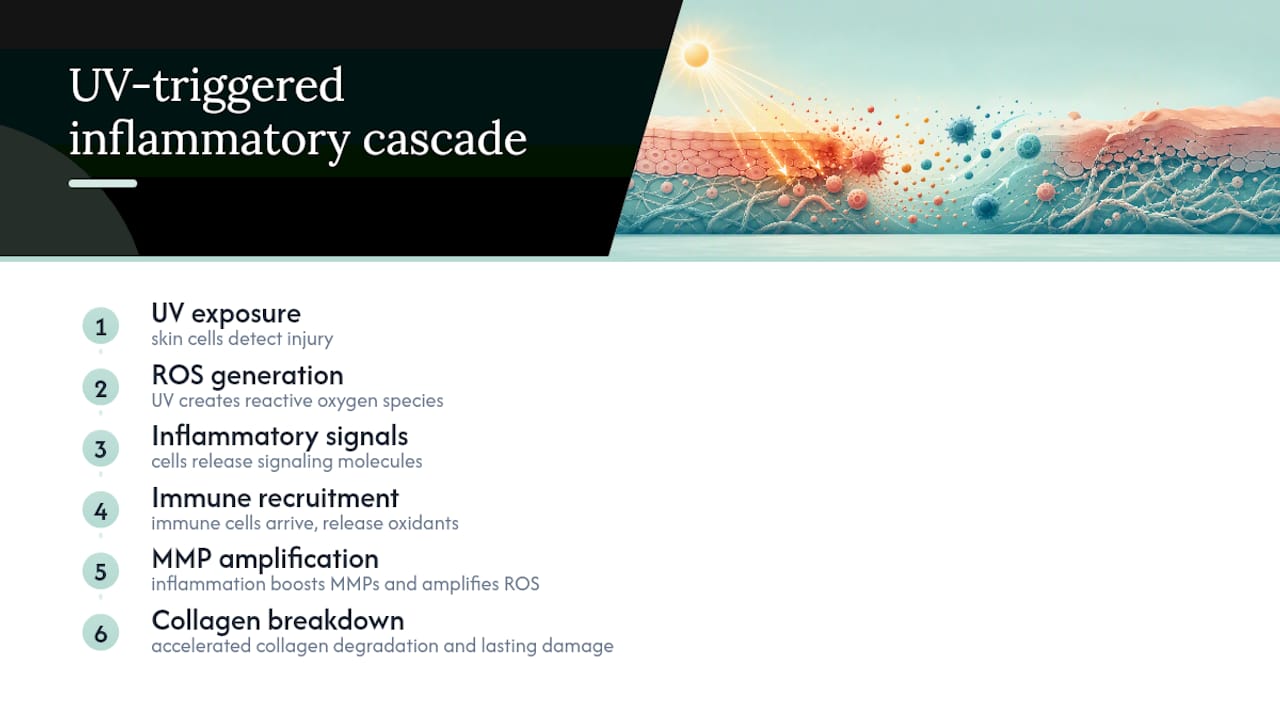
This is why a bad sunburn does more lasting damage than a mild, gradual tan. The inflammatory response recruits immune cells to the site, and those cells release their own oxidative compounds on top of what UV already generated directly. You end up with a compounding effect: UV creates ROS, ROS triggers inflammation, and inflammation drives more MMP activity and more ROS in a feedback loop that outlasts the sunburn itself.
Redness fading in a few days doesn’t mean the inflammatory cascade underneath has fully resolved. Deeper dermal inflammation can persist longer than the visible surface reaction, which is part of why repeated burns in your teens and twenties carry consequences that show up decades later. Calming inflammation quickly (cool compresses, avoiding further exposure, gentle hydration) isn’t just about comfort. It’s about shortening the window where collagen-degrading enzymes stay active.
Does Skin Tone Change How Much Collagen You Lose to the Sun?
Melanin absorbs and scatters UV radiation, giving deeper skin tones a measure of built-in protection that lighter skin doesn’t have. That’s real biology, not a myth. But “some protection” is not the same as “protected,” and this is one of the most common misunderstandings younger adults carry into their sun habits.
Melanin reduces UV penetration, it doesn’t block MMP activation or oxidative stress entirely. Deeper skin tones still experience collagen fragmentation from cumulative sun exposure, just at a slower visible rate. That’s precisely why photoaging on darker skin often shows up differently: less fine-line wrinkling, more textural unevenness, hyperpigmentation, and dermal thickening changes that are frequently underdiagnosed because clinicians and patients alike associate “sun damage” primarily with lighter-skin wrinkling patterns.
Lighter skin tones offer less natural UV filtering, which means the same molecular process, ROS generation and MMP-driven breakdown, gets underway faster and with less built-in buffering. The mechanism is identical across skin tones. Only the timeline and visible presentation differ. Every skin type benefits from daily SPF, but assuming pigment alone is sufficient protection is a gap worth closing early, particularly since pigment-prone skin also faces higher risk of UV-triggered dark spots, a connection worth understanding in more depth.
Photoaging vs. Natural Aging: Two Different Collagen Stories
Collagen loss happens to everyone eventually, sun or no sun, but the two processes work through different mechanisms and on very different timelines. Intrinsic aging is genetically programmed. Collagen production slows gradually starting in your mid-twenties, at a roughly steady, predictable rate regardless of lifestyle.
Photoaging is a different animal entirely. It’s driven by the MMP-mediated enzymatic breakdown described earlier, and it’s dose-dependent rather than time-dependent. Two 30-year-olds with identical genetics can have dramatically different collagen health if one spent a decade sunbathing and the other stayed diligent about SPF. Cumulative UV exposure, not calendar age, is the deciding factor.
The visible differences matter for how you think about prevention. Intrinsic aging tends to produce fine, even wrinkling and gradual volume loss. Photoaging produces deeper, more textured wrinkling, uneven pigmentation, and the leathery thickening pattern known as solar elastosis, changes tied to that measurable drop in type I collagen expression seen in chronically sun-exposed skin.
Here’s the practical upshot: you can’t stop intrinsic aging, but photoaging is largely optional. Most of what people call “premature aging” is really accumulated UV damage stacked on top of normal biological aging, and the UV portion responds directly to prevention in a way genetics never will.
When Pollution Teams Up with UV to Damage Collagen
Sun exposure rarely happens in a vacuum, and environmental pollutants can make UV-driven collagen damage worse. Airborne particulate matter and ozone generate their own oxidative stress on skin, adding to the ROS burden that UV already creates. In urban environments, skin is essentially fielding two oxidative assaults at once.
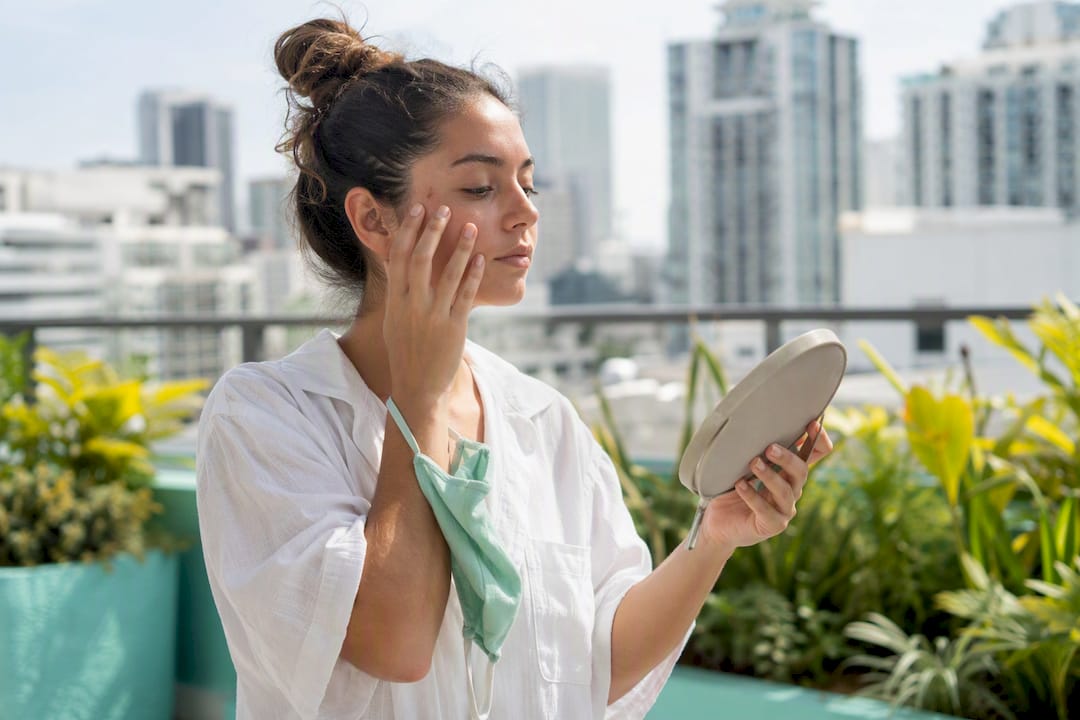
The mechanism overlaps in a way that compounds rather than simply adds. Pollutants can deplete skin’s natural antioxidant reserves, the same defenses that would otherwise help neutralize UV-generated free radicals. With that buffer weakened, UV exposure does comparatively more damage than it would in a low-pollution environment, even at identical sun exposure levels.
This matters for anyone living in or regularly visiting cities, especially given how much time young adults spend in dense urban settings without necessarily changing their sun-protection habits to match. A topical antioxidant serves double duty here: it helps counter both UV-generated and pollution-generated oxidative stress, which is part of why dermatologists frequently recommend antioxidant layering, not just SPF, for anyone in a high-pollution area. Combining broad-spectrum sunscreen with an antioxidant isn’t redundant protection. It’s addressing two separate oxidative sources that happen to converge on the same collagen fibers.
What the Science Actually Tells You to Prioritize
The conventional wisdom on sun protection treats SPF like an afterthought, something you slap on before a beach day and forget the rest of the week. The research doesn’t support that framing. MMP activity from a single unprotected exposure stays elevated for days, which means the real risk isn’t the one big sunburn you remember. It’s the dozens of small, forgettable exposures nobody tracks: the commute, the lunch break outside, the fifteen minutes walking the dog.
What’s genuinely overrated is chasing expensive repair treatments while skipping the fifteen-second habit that prevents most of the damage in the first place. Retinoids and professional procedures have real value, but they’re playing defense against a problem that daily SPF mostly prevents from happening. If you’re 22 and inconsistent with sunscreen but loyal to your retinol, you have your priorities backward.
Start with the boring habit. Broad-spectrum protection, applied daily, reapplied when you’re actually outside. Everything else, antioxidants, retinoids, professional treatments, works better as a second layer once that foundation is solid, not as a substitute for it.
— Ayssa
Building Your Prevention Routine with Miamibeachbum
Prevention beats repair, and the easiest way to make SPF a daily habit is to use products built for actual beach-and-sun life rather than a clinical routine you’ll abandon by August. Blocked SPF50 is a reef-safe mineral sunscreen made for daily body coverage, while Save Face SPF50 handles the same job for your face without the heavy, greasy feel that makes people skip reapplication.
Post-sun care matters just as much as prevention. Bum + Body Cream calms irritation and helps manage the body breakouts that show up after a day of sweat, sunscreen, and salt water, and Coco Body Scrub clears away dead skin buildup so your skin barrier can actually absorb what you put on it. If you’re not sure where to start, the Bodycare Discovery Set bundles the essentials together so you can build a full routine without guessing which product to buy first.
Ready to build a routine that actually protects your collagen instead of just your tan line? Shop the Bodycare Discovery Set and start with daily protection today.
Sources
- Photoaging (Sun Damage) | Yale Medicine
- Natural and sun-induced aging of human skin (PMC)
- Sun-Damaged Skin: Photoaging, Signs, Causes & Treatment | Cleveland Clinic
- Photodegradation of collagen (PMC)