


An indie beauty brand is a skincare, hair care, or cosmetics company that stays independently owned and isn’t part of a large corporate beauty conglomerate. The founder still calls the shots, the brand answers to its customers instead of shareholders, and the product line reflects one person’s vision rather than a boardroom’s market research.
A few traits show up again and again:
- Founder-led: the person who started it still shapes what it becomes.
- Direct-to-consumer focus: most sales happen through the brand’s own site and social channels, not big-box shelves.
- Niche focus: indie brands solve a specific problem instead of trying to please everyone.
- Mission-driven: the “why” behind the brand matters as much as the product itself.
Miamibeachbum, a sun-obsessed body care line built around reef-conscious formulas, is one working example of what that looks like in practice.
Key Takeaways
An indie beauty brand is defined by independent ownership and founder control, not by size, price, or aesthetic.
| Point | Details |
|---|---|
| Ownership is the real test | A brand is indie only while it stays outside conglomerate ownership, regardless of revenue size. |
| Funding isn’t disqualifying | Taking VC or private equity money doesn’t end indie status; losing founder control does. |
| Indies drive real market share | NielsenIQ found indie brands hit $30.5 billion in sales and about 32% dollar share in beauty. |
| DTC is the default channel | Indie brands captured a larger share of online beauty sales compared to in-store sales |
| Miamibeachbum reflects the model | Its founder-driven, reef-conscious formulas across products like Blocked SPF50 and Hair Shield show indie traits in practice. |
Table of Contents
- What Makes a Beauty Brand Indie, According to the Industry
- How Indie Beauty Brands Actually Go to Market
- Why Indie Beauty Brands Matter to Shoppers
- How to Tell if a Brand Is Really Indie
- Who’s Behind This Guide
- What the Term “Indie” Gets Wrong
- See Indie Principles in Action at Miamibeachbum
- Sources
What Makes a Beauty Brand Indie, According to the Industry
Trade press and market analysts don’t use “indie” loosely. Independent ownership is the anchor. A brand that gets folded into a conglomerate’s portfolio, even if the founder stays on as a figurehead, stops being indie in any meaningful sense. What matters is who controls the decisions, not just whose name is on the label.
NielsenIQ’s tracking sets a revenue ceiling for a brand to still get classified as indie, provided it remains independently owned and operated. That threshold isn’t a hard legal line, but it’s the working guideline analysts use when they say a brand is “still indie” or has “graduated” out of the category.
Beyond ownership, three things separate an indie brand from a mass-market one:
- The founder is visibly involved in product decisions, not just marketing.
- Product development responds to a specific, often underserved need.
- Founder involvement and identity-driven development tend to define the brand’s DNA more than any single product does.
Here’s where it gets nuanced: taking venture capital or private equity money doesn’t automatically disqualify a brand from indie status. Funding and ownership are two different questions. A brand can raise outside capital and still keep founder control over the actual business, which is the distinction that determines whether it counts.
How Indie Beauty Brands Actually Go to Market
Indie brands rarely launch with a shelf spot at a national retailer. They build online first, sell direct, and let the product cycle move at the speed of their own decision-making instead of a corporate approval chain — a strategy explained in detail in this guide to finding trustworthy beauty blogs.
- Launch direct-to-consumer. Most indie brands sell through their own website before, or instead of, chasing retail placement.
- Build through social feedback. Instagram comments and TikTok duets often function as unpaid product testing.
- Iterate fast. A smaller team means fewer approval layers, so a formula tweak can happen in weeks, not quarters.
- Hit scaling friction. Distribution, regulatory approval, and supply chain limits are where indie brands usually struggle compared to bigger players.
That online-first push shows up in the numbers, too. Indie brands captured a larger share of online beauty sales compared to in-store sales, which tells you exactly where their strength lies and where it doesn’t.
Pro Tip: If you’re trying to gauge how “indie” a brand really is, check where it sells. A brand that’s mostly DTC with a few specialty retail accounts is behaving very differently from one that’s already on drugstore shelves nationwide.
The tradeoff for that speed is real. Smaller teams mean less leverage with manufacturers, slower international shipping, and tighter margins when a product goes viral faster than the supply chain can handle.
Why Indie Beauty Brands Matter to Shoppers
Indie brands function as the beauty industry’s testing ground. They try ingredients and formats before conglomerates are willing to bet a national launch on them, and they often get there first because they don’t need internal sign-off from six departments.
NielsenIQ found indie beauty brands represented a significant portion of sales and dollar share in the beauty market, growing faster than the category overall in that measurement period. That’s not a rounding error. It’s a meaningful chunk of where beauty dollars actually go, and it’s why bigger companies keep a close eye on what indies are doing.
What shoppers get in return:
- Formulas built around one specific concern instead of a broad, everybody-friendly formula.
- Ingredient transparency, since founders often answer directly in comments and DMs.
- Faster access to trend-forward categories, like reef-safe sun care or targeted body treatments, before they go mainstream.
- A direct line to the person actually making the product.
Reef-conscious sun care is a good example of a niche indie brands got to before most of the mass market did, largely because a founder who cared about ocean health didn’t need a committee’s approval to formulate around it.
How to Tell if a Brand Is Really Indie
Marketing copy will tell you a brand is “indie” whether or not it’s true. Checking the actual signals takes about five minutes and saves you from buying into a story that isn’t accurate.
Start with these checks:
- Search the brand name plus “acquired” or “parent company” to see if a conglomerate owns it.
- Look for a founder’s name, face, or story on the site, not just a generic “our mission” page.
- Check where it sells: heavy DTC and specialty retail usually signals indie; wall-to-wall placement at big-box chains usually doesn’t.
- Read ingredient pages closely. Vague claims without specifics are a weaker transparency signal than a full ingredient breakdown.
Then work through this order when you’re unsure:
- Confirm ownership first. This overrides everything else.
- Check for outside funding, but don’t treat it as disqualifying on its own.
- Look at founder visibility in interviews, social posts, and press.
- Compare distribution footprint against company size.
- Weigh transparency claims against what’s actually listed on the product page.
Pro Tip: A brand accepting VC money isn’t automatically “selling out.” The real question is whether the founder still controls product decisions, or whether a new owner does.
Who’s Behind This Guide
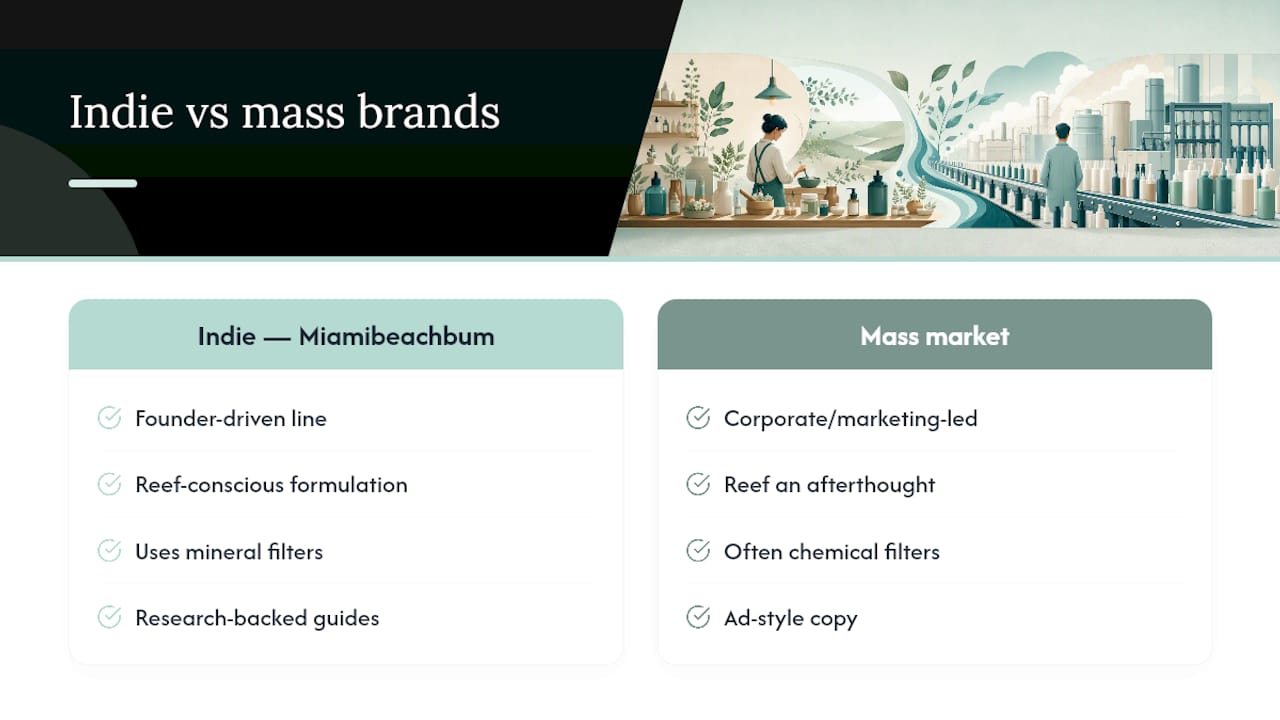
This piece is written by Ayssa, a contributor to Miamibeachbum’s blog focused on sun and body care, where the brand publishes research-backed guides on ingredients and formulation choices readers can actually verify.
Miamibeachbum’s own focus on reef-conscious beauty is itself a case study in the indie traits this article describes: a founder-driven product line built around a specific environmental concern that most mass-market sun care brands still treat as an afterthought.
Reef-conscious formulation isn’t a marketing checkbox. It means choosing mineral filters and marine-safe ingredients because the ocean is where the product ends up after a swim, not because a label needs a buzzword.
That kind of specificity, writing about ingredient choices with the reasoning behind them spelled out, is what separates an indie brand’s content from a mass brand’s ad copy.
What the Term “Indie” Gets Wrong
The biggest misconception about indie beauty is that it’s about size or price point. It isn’t. It’s about who’s making the decisions. A brand can have a modest catalog and still not qualify as indie if a conglomerate owns the parent company; a brand can grow considerably and still qualify if the founder keeps control.
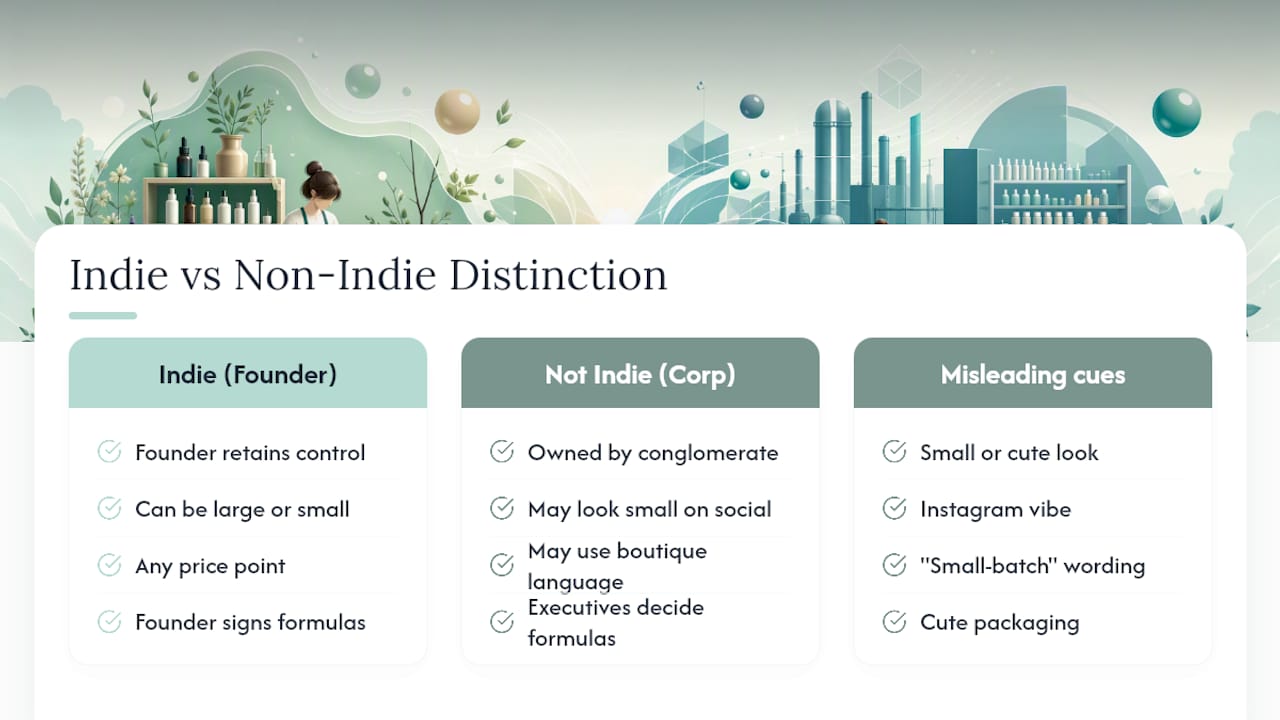
The conventional advice, “look for small, cute, or boutique,” misses the point entirely. Some independent brands scale significantly while founders retain real influence, and trade analysts still call them indie. Meanwhile a brand can look small and quirky on Instagram while quietly belonging to a company with a dozen other labels in its portfolio.
What I’d prioritize first: ownership over aesthetic. Skip the vibe check and go straight to who actually owns the company and who signs off on the formula. Everything else, the packaging, the founder’s Instagram voice, the “small batch” language, is downstream of that one fact. Get that right and the rest of the evaluation gets a lot easier.
See Indie Principles in Action at Miamibeachbum
Miamibeachbum is a founder-driven body and sun care brand built around one focused idea: sun protection and body care shouldn’t come at the ocean’s expense. That’s the indie model in practice, one team, one mission, and formulas built around a specific problem instead of trying to be everything to everyone.
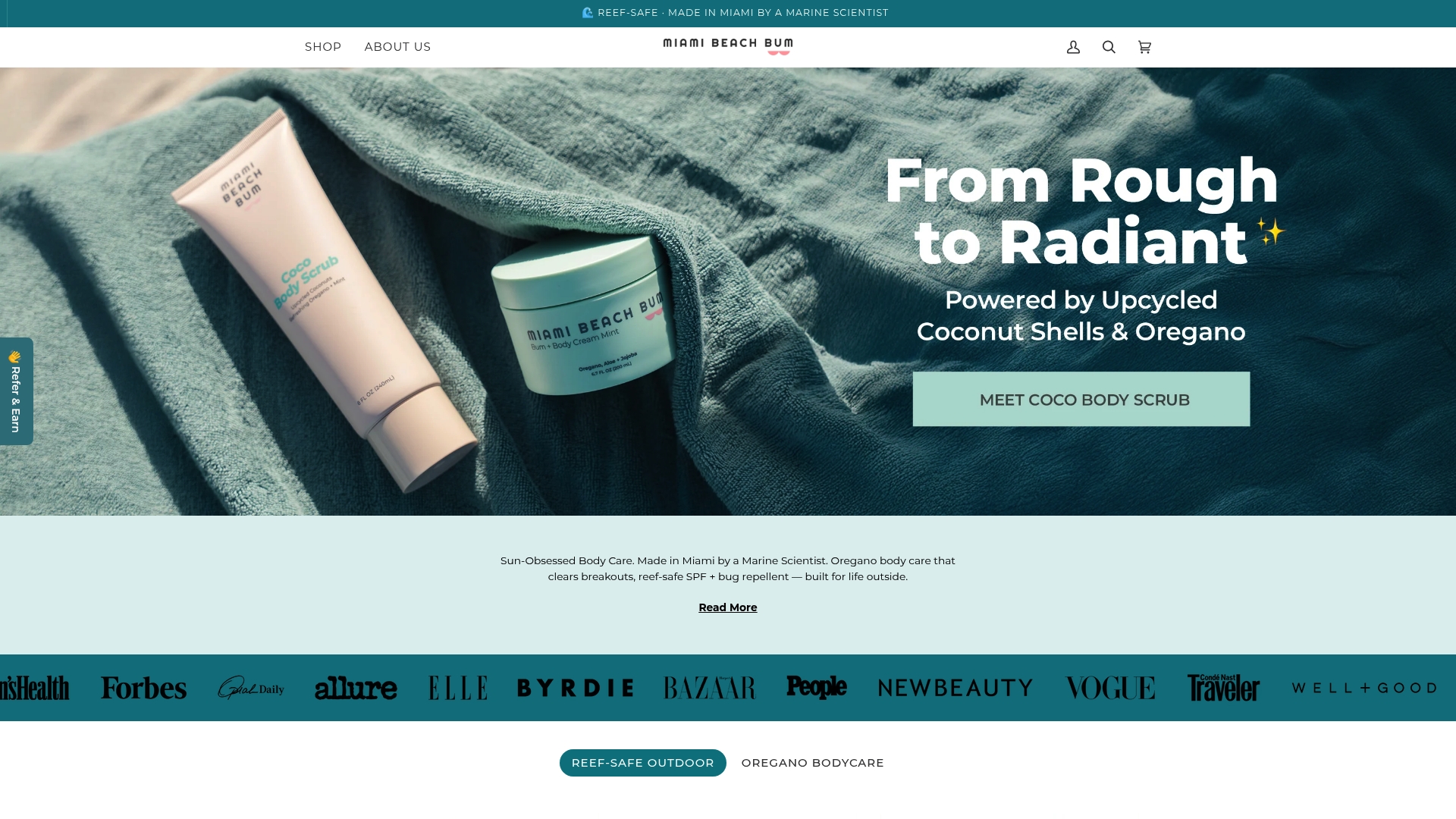
The catalog reflects that focus directly. Blocked SPF50 is a mineral sunscreen built for reef safety without the chalky finish most mineral formulas leave behind. Bum + Body Cream targets razor burn and body breakouts, a niche problem most mass-market brands skip entirely. Hair Shield is a leave-in conditioner made for hair that’s been through salt water and sun, not just a generic detangler. And the Coco Body Scrub uses marine and botanical ingredients to exfoliate without stripping skin the way many drugstore scrubs do.
If you want to see how an indie brand’s ingredient choices actually hold up, start with the Blocked SPF50 product page and check the formula for yourself.
Sources
- Indie Beauty Check-Up: Brand Founders Give Their Reads On The Segment’s Health | Beauty Independent