


Rinse your hair with fresh water for a full minute before you do anything else. That single step limits how much salt and chlorine your strands absorb. From there, shampoo within a few hours if your scalp runs oily or you swam more than once, follow with a hydrating conditioner or leave-in, and detangle before your hair dries. Skip the tight ponytail until it’s fully dry.
TL;DR:
- Rinsing hair thoroughly with cool water for at least a minute immediately after swimming significantly reduces salt and chlorine absorption, preventing damage.
- Shampooing should be done within a few hours for oily scalps or frequent swimmers, while dry or sensitive scalps can wait longer between washes to preserve moisture.
- Applying conditioner, masks, or leave-in treatments from mid-lengths to ends helps repair salt and sun damage; ingredients like hydrolyzed proteins and ceramides are especially beneficial.
- Handling wet, salt-stressed hair gently by blotting and detangling with fingers minimizes breakage, and air drying is preferable to heat styling until hair is fully dry.
- Using a lightweight barrier product before swimming and reapplying after washing can prevent damage, and good hydration and protein intake boost natural repair after beach exposure.
Table of Contents
- Your Two-Minute Post-Beach Hair Checklist
- How to Rinse and When to Shampoo
- Cleansing Without Causing More Damage
- Hydration and Repair for Salt-Stressed Hair
- Detangling and Drying Without Breaking Hair
- The Post-Beach Mistakes That Do the Most Damage
- Adjusting the Routine for Your Hair Type
- Tips Ayssa and the Miami Beach Bum Team Actually Use
- What to Eat and Drink for Hair Recovery
- Why the Two-Minute Rinse Beats Every Other Beach Hair Fix
- Why Hair Shield Belongs in Your Beach Bag
- Where This Advice Comes From
- Sources
- FAQ
Your Two-Minute Post-Beach Hair Checklist
Most beach hair damage happens in the gap between leaving the water and actually washing it out. Close that gap fast with this order:
- Rinse immediately with lukewarm to cool water, working it through the scalp and down the full length for at least a minute. This is the single most effective post beach hair routine step, according to Cleveland Clinic.
- Finger-comb out sand while hair is wet, starting at the ends before you reach the scalp.
- Check for sunscreen residue. If hair feels waxy or looks dull, plan a proper cleanse rather than a rinse-only day.
- Tie hair loosely, if at all, using a scrunchie or soft cloth scrap instead of a thin elastic.
- Decide on shampoo now or later. Oily scalps and daily swimmers should wash soon; dry or sensitive scalps can often wait.
How to Rinse and When to Shampoo
Hair works something like a sponge. It’s porous, and once the cuticle lifts from sun and salt exposure, it soaks up whatever it’s sitting in, whether that’s ocean water, pool chlorine, or the sunscreen sliding off your shoulders. Rinsing first blocks a lot of that absorption before it locks in.
The rule that matters most: rinse thoroughly for a full minute, and finish with the coolest tolerable water. Cooler water helps the cuticle contract and lie flat again, which is part of why Traya recommends starting lukewarm to loosen buildup, then dropping the temperature at the end.
Pro Tip: A full minute feels longer than you think. Count it out or hum through a song chorus so you don’t cut it short.
Shampoo timing depends on your scalp, not just your hair:
- Oily scalps and anyone swimming daily should shampoo after most sessions.
- Dry or sensitive scalps can rinse most days and shampoo every second or third day instead.
- Frequent swimmers do best alternating a mild sulfate-free shampoo with a co-wash, so the scalp stays clean without stripping moisture every single day.
Cleansing Without Causing More Damage
The technique matters as much as the product. Rub shampoo directly onto salt-stressed lengths and you’re adding friction to hair that’s already weakened. Lather it in your hands first instead:
- Work shampoo into a foam between your palms before it touches your head.
- Apply that foam to the scalp only, massaging gently.
- Let the suds travel down the lengths as you rinse, cleansing without scrubbing.
That lather-in-hands method comes straight from Traya’s post-swim guidance, and it’s one of the simplest swaps you can make this summer.
Clarifying or chelating shampoos have a real job: stripping heavy mineral deposits or sunscreen film that a regular cleanser can’t touch. But they’re strong enough to over-dry hair that’s already dealing with sun and salt stress, so save them for genuine buildup, not a weekly habit.
Pro Tip: If your hair feels waxy even after a normal wash, that’s buildup. If it feels rough and straw-like right after rinsing, that’s dryness. Clarify for the first, moisturize for the second.
For daily cleansing, look for pH-balanced, sulfate-free formulas with mild surfactants. They clean without dragging out the moisture you’re trying to protect.
Hydration and Repair for Salt-Stressed Hair
Rinsing and cleansing stop the damage from getting worse. Repair is where you actually reverse it. Salt water roughens the cuticle, and repeated exposure without follow-up moisture eventually shows up as brittleness and faster color fade, per Cleveland Clinic. Sealing that cuticle back down is the job of your conditioner, mask, and leave-in.
Apply conditioner from mid-lengths to ends, where sun and salt exposure cause the most damage, and skip the scalp unless the formula says otherwise. Masks can sit for 5 to 20 minutes depending on the product; check the label rather than guessing.
What to look for in ingredients:
- Hydrolyzed proteins to patch protein loss from sun and salt exposure.
- Ceramides to help rebuild the lipid layer that keeps moisture in.
- Botanical oils and shea-type emollients for slip and softness on dry ends; many natural options are available in specialized beard oils that are rich in plant oils.
- Humectants like glycerin to pull moisture back into the strand.
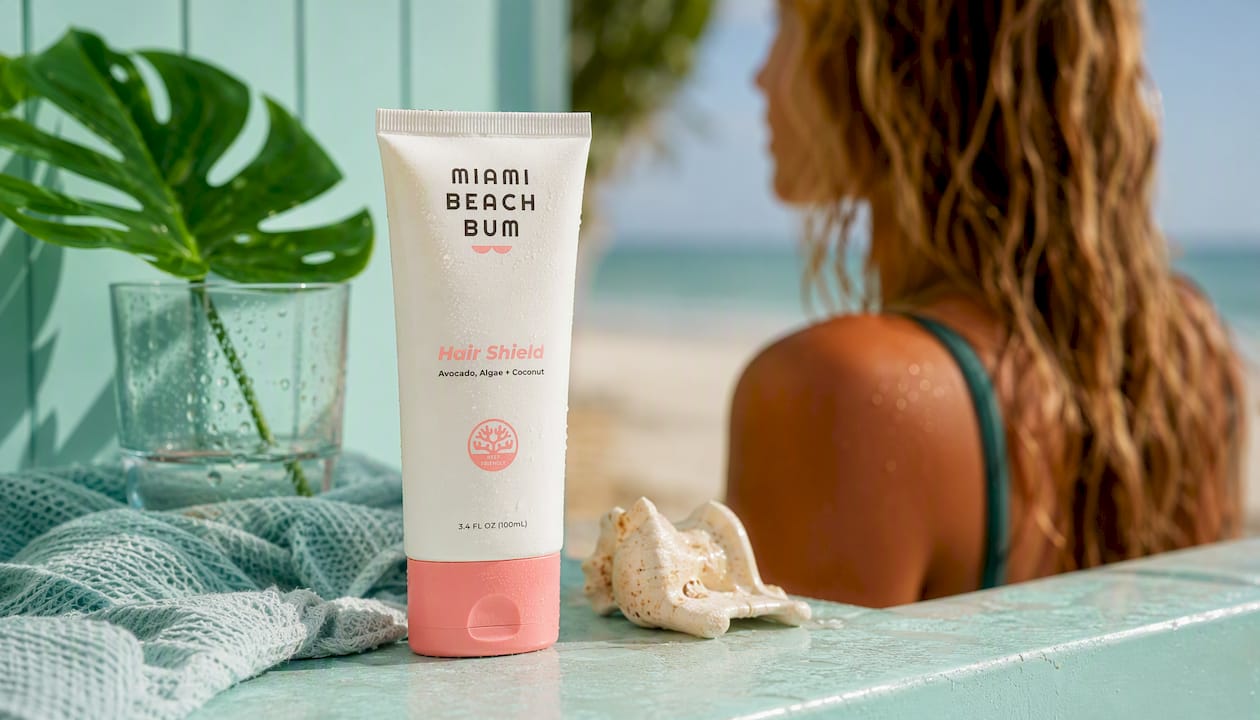
Save the heavy oils for nighttime or the ride home. At the beach, they just give sand something to stick to. A lightweight leave-in or a barrier like Hair Shield works better in the moment, sealing in moisture without turning your hair into a sand magnet.
Detangling and Drying Without Breaking Hair
Wet hair is fragile hair, and salt-stressed wet hair is even more so. Handle it in this order:
- Blot with a microfiber towel or soft cotton shirt. Squeeze gently, don’t rub or wring.
- Detangle while conditioner or mask is still in, starting at the ends and working up with fingers or a wide-tooth comb.
- Air-dry whenever you can. If you need heat, use the lowest setting with a heat protectant.
- Leave hair loose or in a soft, low style until it’s fully dry.
That fingers-first detangling approach lines up with standard salon technique for minimizing breakage on stressed lengths, and it costs you nothing but a few extra minutes.
The Post-Beach Mistakes That Do the Most Damage
A few habits undo everything else on this list:
- Tight ponytails or buns on wet hair. Wet strands are at their weakest, and Bezzia notes tight elastics reliably cause breakage right at the tie point.
- Hot water rinses or immediate heat styling. Both open the cuticle further when it needs to close.
- Daily clarifying shampoo. Save it for real buildup, not routine washing.
- Letting salt or chlorine dry into your hair. Once it sets, it’s harder to remove and does more cumulative harm.
Adjusting the Routine for Your Hair Type
The rinse-cleanse-repair sequence stays the same for everyone. What changes is how you fill in the details.
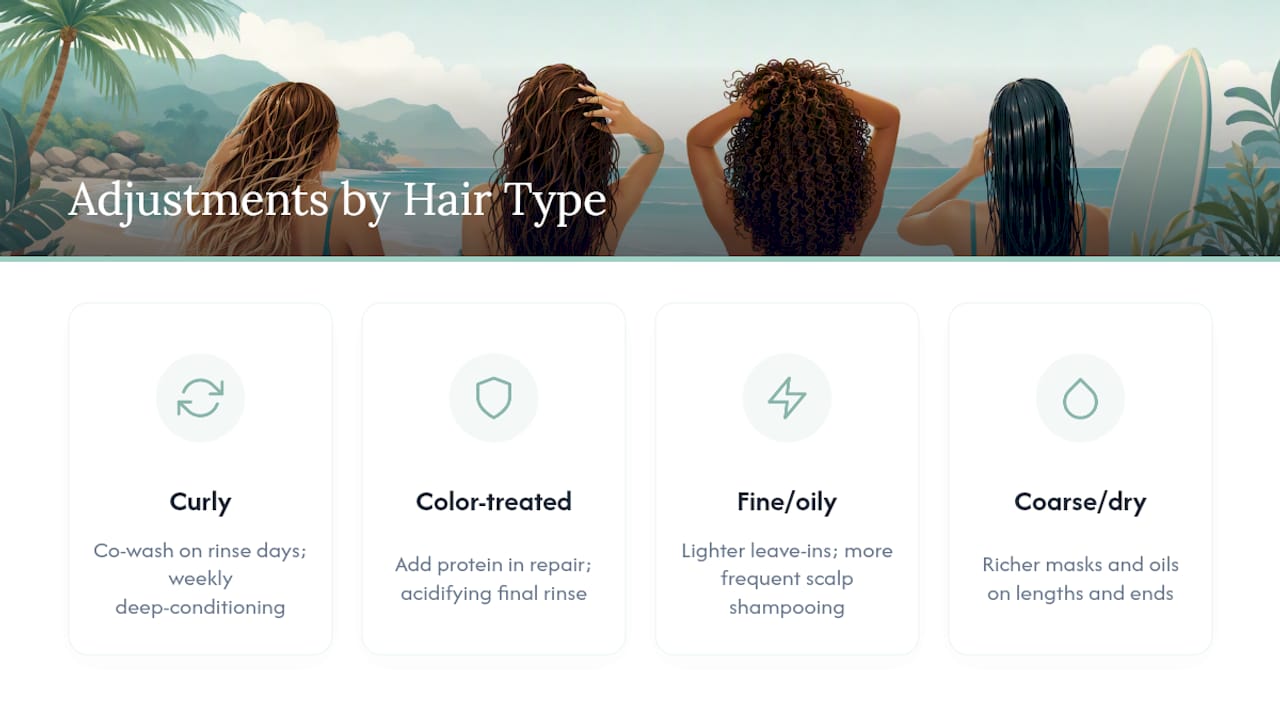
Curly hair does better with co-washing on rinse-only days instead of shampoo, plus a weekly deep-conditioning treatment. Finger-detangle in sections rather than dragging a brush through dry curls.
Color-treated or bleached hair needs a protein boost added to the repair step, plus an acidifying final rinse to help flatten the cuticle and hold onto color. Skip anything with sulfates when you can.
Fine or oily hair wants lighter leave-ins and more frequent scalp-focused shampooing, since heavy products weigh it down fast. Go easy on oils; a few drops on the ends is plenty.
Coarse or dry hair can handle richer masks and oils concentrated on the lengths and ends, and needs clarifying far less often than other types. Moisture retention is the priority here, not stripping.
Tips Ayssa and the Miami Beach Bum Team Actually Use
Ayssa’s advice for Miami Beach Bum readers keeps coming back to one habit: rinse the second you’re out of the water, before you towel off, before you reapply sunscreen, before anything else. It sounds too simple to matter, but that early window is when most of the salt uptake happens.
The other habit worth stealing is pre-wetting hair and applying a lightweight leave-in barrier before you swim at all, echoing the pre-swim guidance stylists give for reducing salt and chlorine absorption in the first place. A reef-safe leave-in works both ends of the day: coat it on before you swim, then reapply a small amount after your post-swim wash to reseal moisture. For the full pre- and post-swim sequence, Miami Beach Bum’s pre swim and post swim steps walk through both halves in more detail.
What to Eat and Drink for Hair Recovery
Hair repair isn’t only a topical job. What you eat and drink in the days after heavy sun and salt exposure affects how fast your hair bounces back, because the follicle depends on nutrients delivered through the bloodstream, not just what you apply on the outside.

Water is the simplest lever. Sun exposure and time in the ocean both pull moisture from your body, and dehydration shows up in hair as dullness and slower growth, on top of the dry skin and fatigue you’ll notice first. Aim to replace fluids steadily through a beach day, not just after you notice thirst.
Protein matters because hair is built from keratin, a protein structure. A day of light eating at the beach, followed by a protein-poor dinner, gives your hair less raw material to repair itself with overnight. Eggs, fish, beans, and Greek yogurt are easy ways to close that gap.
Omega-3 fatty acids, found in fish like salmon and in walnuts and flaxseed, support the scalp’s natural oil production, which helps counteract the drying effect of salt water. Vitamin C, from citrus fruits and berries, aids collagen production, which supports the hair follicle. Zinc and biotin, found in nuts, seeds, and whole grains, also play a supporting role in keeping hair growth on track.
None of this replaces the rinse-cleanse-repair sequence. It just makes the repair work faster.
Why the Two-Minute Rinse Beats Every Other Beach Hair Fix
Most beach hair advice buries the one step that actually moves the needle under a pile of product recommendations. The rinse matters more than the shampoo you buy, more than the mask you leave on for twenty minutes, and more than any leave-in on the market. Skip it, and you’re asking a good conditioner to undo damage that never had to happen.
The conventional wisdom oversells “beach hair” as effortless. It’s not. That tousled, wavy texture is salt roughening your cuticle, and the same mechanism that gives you the look is the one that dries you out if you never follow up. Nobody tells beachgoers this trade off honestly, they just sell you the wave.
If you take one thing from this article, prioritize the rinse over everything else. Buy the good conditioner, use the leave-in, adjust for your hair type. But do those things after you’ve already spent sixty seconds under a hose or an outdoor shower. Skipping that step and going straight to a rich mask is like moisturizing over a sunburn instead of getting out of the sun first.
— Ayssa
Why Hair Shield Belongs in Your Beach Bag
If your hair goes from beach to shower to bed without a barrier in between, you’re relying entirely on rinsing and repair to undo what the sun and salt already did. Hair Shield closes that gap by working on both ends of the day.
Apply it before you swim to coat strands with a lightweight layer that slows salt and chlorine absorption, then use a small amount again after your post-swim wash to seal in moisture while the cuticle is still settling. It’s built with botanical and marine ingredients rather than heavy oils, so it won’t turn your hair into a sand trap the way a thick oil treatment does. People with frequent swimming habits, color-treated hair, or dry ends may find it especially beneficial. It’s convenient enough to carry in a beach bag alongside your sunscreen, helping to maintain the protective step consistently. Pick up Hair Shield before your next beach trip and build the habit in from day one.
Where This Advice Comes From
The rinse and shampoo timing guidance in this article draws on Cleveland Clinic’s research on saltwater’s effect on hair and skin, along with Traya’s breakdown of lather technique and wash frequency for swimmers. The mistakes to avoid, especially around wet-hair styling, come from Bezzia’s expert-sourced beach hair routine.
Sources
- Is Salt Water Good for Your Hair and Skin? — Cleveland Clinic
- Shampoo after sea water — Traya
- Hair care at the beach: mistakes to avoid and the routine recommended by experts — Bezzia
FAQ
Why does my hair look so good right after the beach?
Salt water temporarily roughens the hair cuticle, which creates the tousled, wavy texture people call “beach hair.” It’s a cosmetic effect from cuticle disruption, not a sign of healthy hair, and it fades into dryness without a proper rinse and repair routine.
Are you supposed to wash your hair after the beach?
You should rinse with fresh water immediately, then shampoo within a few hours if you have an oily scalp or swam multiple times; dry or sensitive scalps can often do rinse-only and shampoo less frequently.
How can I protect my hair from beach damage?
Apply a protective leave-in like Hair Shield or a lightweight oil before swimming to reduce salt and chlorine absorption, then rinse for a full minute the moment you’re out of the water.
Should I style my hair before or after the beach?
Keep styling loose and minimal before the beach, since tight elastics on hair that’s about to get wet and salty set you up for breakage; save any real styling for after you’ve rinsed, cleansed, and conditioned.